by David Berridge
If I sat next to the painter Walter Sickert, in a London music hall in 1887, I might get distracted. Before people sat in theatre seats checking their phones during plays, Sickert had a small sketchbook that fit into his palm. He drew performers, fellow audience members, the “chairman” who announced the acts, and musicians in their pit, as well as the ornate architecture and decoration around them. He sketched top hats of watching men, a woman holding a baby, the stage up from the stalls and lines of men hanging precariously over the highest balcony. He loved how long mirrors around the stage and gallery formed for the artist of modern life a mosh pit of sight lines and perspectives.
Sickert worked in whatever shifting beams and pools of light and dark were available, the sketchbook in the air and the person behind loudly complaining. Or maybe he sat, legs cramped and torso twisted, head up and tilting back whilst a drawing hand and arm faced forwards on his lap, never looking at his sketchbook. If Sickert was still alive (he died in 1942, aged 81) I would visit him at home in his old age, like Victor Pasmore, Denton Welch, and other young artists. I would tell him such methods were now called somatic notation, embodied knowledges, affective attunement. Sickert would snort. How, I would ask, did he condense, absorb, combine, from all those drawings, when evenings in a darkened auditorium became studio time in front of a canvas?
My favorite of Sickert’s theatre paintings is of the singer Ada Lundberg, during one of her regular gigs at the Marylebone Music Hall, which was part of the Rose of Normandy public house, at 32-3 Marylebone High Street. Unlike Minnie Cunningham at the Old Bedford (1892) with its shimmering, hallucinatory performer alone on the world apart of the stage, Lundberg could almost be singing across a bar table. The painting is now titled Bonnet et Claque. Ada Lundberg at the Marylebone Music Hall (c.1887) but has at different times been named after tunes Lundberg sung, which indicate the nature of her act: ‘I’ll let him see, between you and me, that I’m his mother-in-law’ and ‘It all comes from sticking to a soldier.’ Claque, I read in Wendy Baron’s magisterial Sickert catalogue raisonné, are audience members paid to follow particular singers between venues. As Sickert paints it, Lundberg hires four ghoulish, bowler-hatted men who share their complexion with London’s deadly smog.
*
I am looking at Sickert’s paintings in the catalogue for a 2022 Tate Britain exhibition, because I have been singing. I attend workshops and improvisation circles (choirs are not my thing, but that’s another story) yet most often teach myself, interested in how that works and when it doesn’t, as desire and practice. The books pile up on my desk: singers’ memoirs, biographies, vocal pedagogies, academic essays. I read in them for phrases that by describing something of one singer suggest ways forward for another (me!), be it exercises, biographical anecdotes, gossip, or Occult Hungry Osmosis (my own hopeful invention). There’s a playlist, too: this week Lundberg merges with numerous YouTube videos of jazz vocalist Cassandra Wilson; the falsetto torch songs sung in grainy archival footage of the 2025 documentary It’s never over, Jeff Buckley.
What holds all these together for me is “Duende: Play and Theory,” a lecture delivered by Spanish poet Frederico García Lorca on a 1933 visit to Argentina. Before finding Christopher Maurer’s latest English translation on my bookshelves, I write down what I remember. A Flamenco singer performs in a Granada bar to an unimpressed audience, who sniff that she sounds accomplished but sterile, like something you might hear in Paris. Outraged, she throws back her head to sing with passion, rage, shame. Bravo! shout the audience. Opening the Maurer translation, I read how this is one of the most famous anecdotes in the literature of Flamenco, whereby (to restore its local detail) a (likely fictional) flamenco session (juerga) takes place in an unnamed bar of Cádiz. There Pastora Pavón AKA Niña de los Peines, is watched by an audience including several butchers “who are really millennial priests still sacrificing bulls to Geryon,” an “aristocratic Sevillian whore” descended from a famous Flamenco singer, plus a bull rancher “with the air of a Cretan mask” and Iganicio Espelata, “handsome as a Roman tortoise,” who Lorca says shares his smile with mythical Argatonius, King of Tartessus.
As an apprentice singer, I erased this terrifying audience from my memory to keep only the rudiments of how vocal transformation into greater authenticity is attained. Not knowing how to inculcate it, I forgot too Lorca’s poetic detailing, where having “tossed off a glass of burning cazala” a failing performer proceeds “to sing with a scorched throat: without voice, without breath or nuance, but with duende. She was able to kill all the scaffolding of the song to satisfy an audience “which demanded not forms but the marrow of forms.” This voice “no longer playing. It was a jet of blood.” I lift up the Lorca paperback to stare at Sickert’s painting of Ada Lundberg underneath. Perhaps readying myself to perform duende-style, I moisten both lips with my tongue.
*
Ada’s close-up head fills the bottom right of the painting. Onlooking claques fill a much larger area of canvas, but that imagined voice emanating from Lundberg’s open mouth gifts her the frame-filling presence that a centered, solo figure might have in a more conventional portrait. One eye concealed by falling hair, Lundberg’s mouth and oval nostril form an autonomous vocal apparatus for recycling the Marylebone’s clogging atmosphere into sound. Without a clear spatial division of stage and auditorium, Sickert shows the enfolding effect of Lundberg’s singing via two interwoven paint patterns: one of whites, light browns, and creams running from Lundberg’s cheek, the claques onlooking faces, up to her hat and back to the unresolved architectural backdrop. This gets interwoven with the various blacks of her hair, the bows and ties of her hat, the claques amalgamating body-mass, bowler hats and ties. All direct the gaze to the dark stuffing of Lundberg’s circled-red mouth as origin of the universe.
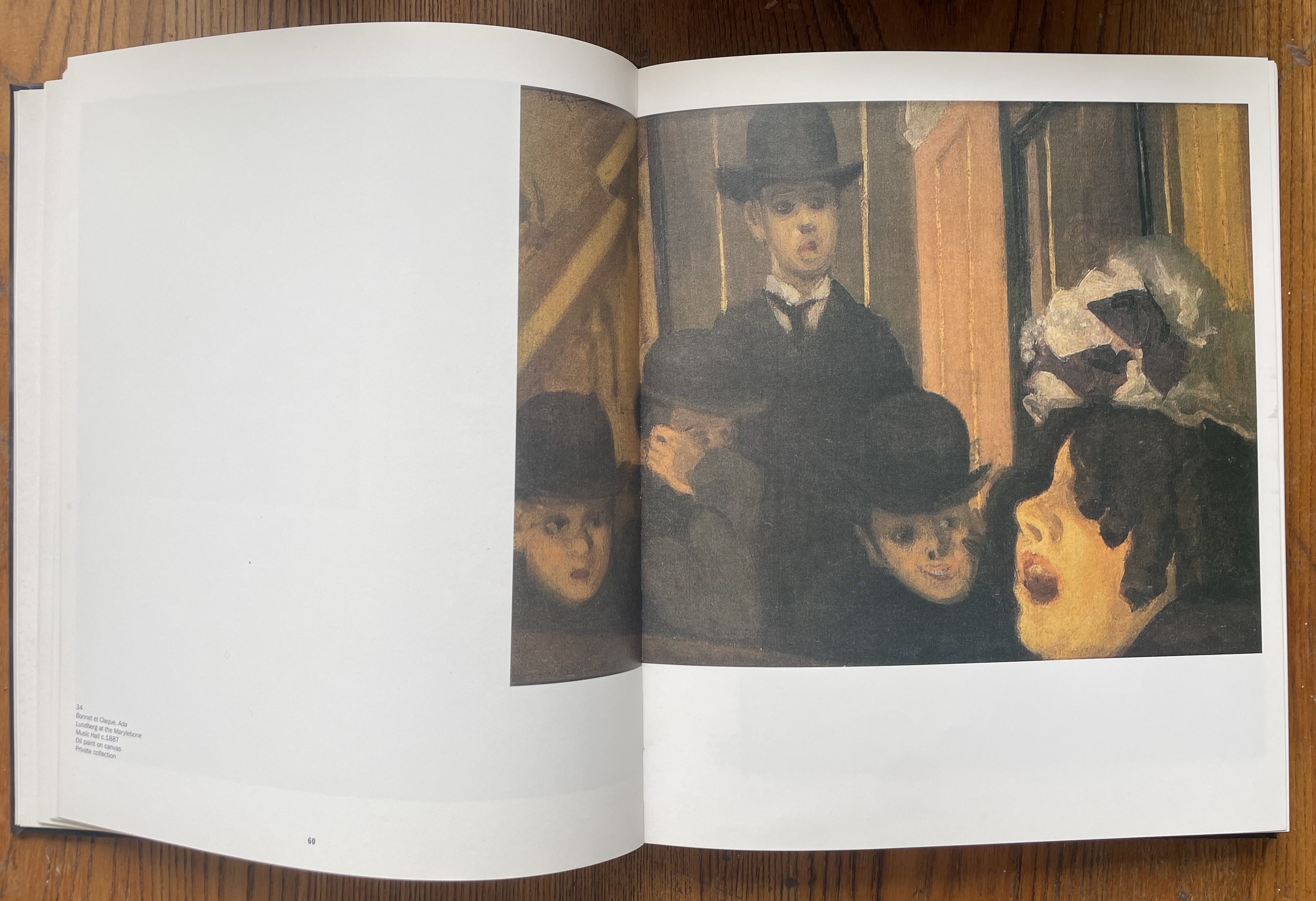
Lundberg emerges, then, less as the comic-performer of ribald and saucy tales than as Victorian Marylebone’s Niña de los Peines, resonating their vocal spell of“not forms but the marrow of forms.” The claque faces behind respond with desire, boredom, envy, bewilderment, absorption and escape. To respond myself I stand up at my desk. Although Sickert only shows a head and small bit of Lundberg’s shoulder, I attempt to recreate the performer’s pose. Look at the painting, draft the stance, make small adjustments to the angle of my neck and chin. When I open my mouth and try to widen one nostril, my eyelids lower as if they are hinged, and a nostril sucks up all four claques into its eager, deep, indrawing of air. Then the upper lip trembles in its mini-curl up closer to the nose, and I feel a falling shaft of throat down to my diaphragm.
On an out breath I activate the vocal cords. Right leg steps back, tilt up of the pelvis, slight squat. The sound surprises, forceful and nasal, so I improvise a mutating vowel sliding from the top of the head onto the soft palette, then across a hard palette to tingle the back of my upper front teeth. My breath runs out then and I stand, emptied, full of possibility, slightly nauseous, with none of Lundberg’s stamina or tough skill. When I look at the reproduction of Sickert’s painting again I see its brushstrokes to be a duende-imbued act of vibrational world-tuning. Then I drink some water.
*
I send Sickert off to Lorca’s bar in Cadiz. What does he see, feel and paint there? Sickert spies Niña de los Peines through heads and over shoulders of her won-over audience, where molten blacks, blood reds and stage-fright yellow flood and mingle amongst felt-in-the-body histories of flamenco, bull slaughter, alcohol, deep song, and something else: a flash of gold-orange paint seems a false step, the painter’s late night stumble in the studio. Until, that is, I return to Lorca’s essay to realize that Sickert’s brush-holding hand registers “those dancing, prancing little homunculi who rise suddenly out of brandy bottles.” Their scorn for the duende-less only the vocal jet of blood counters.
As singer Lauren Newton suggests, I “focus on the inner impulse that arises when you breath in and just before you sing or play but don’t act on it.” I am Lundberg, a claque, then Pavón, as some idea of each of them sculpts about in me, restless like a sketching Sickert in his theatre seat. I flick the Tate catalogue, hold in my mind its painted depictions of iron bedstead, ennui, Venice, Dieppe … How should each sound in me? Wild lament, lullaby, hum, ribald music hall revival: I remove the question marks from that sample of possibilities. After Ada Lundberg, I release and sound the breath.
Works Cited
Wendy Baron, Sickert: Paintings and Drawings (New Haven: Yale University Press, 2006).
Emma Chambers, ed. Walter Sickert (London: Tate, 2022).
Frederico García Lorca, “Duende: Play and Theory”, translated by Christopher Maurer, in José Javier León & Christopher Maurer eds. Finding Duende (Chicago: Swan Isle Press, 2023), pp.45-66.
Lauren Newton, Vocal Adventures: Free Improvisation in Sound, Space, Spirit and Song (Hofheim: Wolke Verlag, 2022).
Anna Greutzner Robins, Walter Sickert: Drawings. Theory and Practice: Word and Image (Aldershot: Scolar Press, 1996).
David Berridge is a writer and anthropologist, currently researching contemporary photobooks, art writing, long looking, and vocal practices as autoethnographic research method. Recent essays appear in ASAP/Journal, GlobalEurope, and The Blue Notebook. A novella, The Drawer and a Pile of Bricks, is published by Ma Bibliothèque.

