by JoLynn Powers
Andrew Wyeth’s wind-swept coastal landscapes have captivated me for most of my adult life. His minimalist approach to watercolor and tempera, combined with his choice of haunting subjects, encourages viewers to fill in the empty spaces in his scenes. Wooden-framed doorways are depicted without figures, leaving us to imagine the people who might pass through them. When Wyeth does include figures, they are often silent models at rest or asleep, making the muted colors of his paintings the focus rather than the people. When he depicts a skiff or sailboat, it is usually resting on a beach, waiting. The paintings evoke a peaceful mood but feel devoid of vitality and energy. They are contemplative rather than engaging, reminiscent of a past we can’t quite reach.
My husband and I first enjoyed a reproduction of Andrew Wyeth’s painting called Spindrift at a small seaside restaurant on Chincoteague Island, along Virginia’s Eastern Shore. We found the painting at The Pearl, an elegant fish-and-steak eatery, located along the Assateague Island Channel. The tiny restaurant, with its large deck, is our favorite place to eat when we visit. Each indoor seating area is separated by a white wall, with ocean-themed paintings hung above sturdy wooden tables and chairs. On our first night there, we were seated beneath the Spindrift print showing a small boat. I lingered over the reproduction as we ordered dinner. The gray skiff rests on the shore, with its sides surrounded by ribbons of sea foam. It felt like a natural part of The Pearl’s décor.
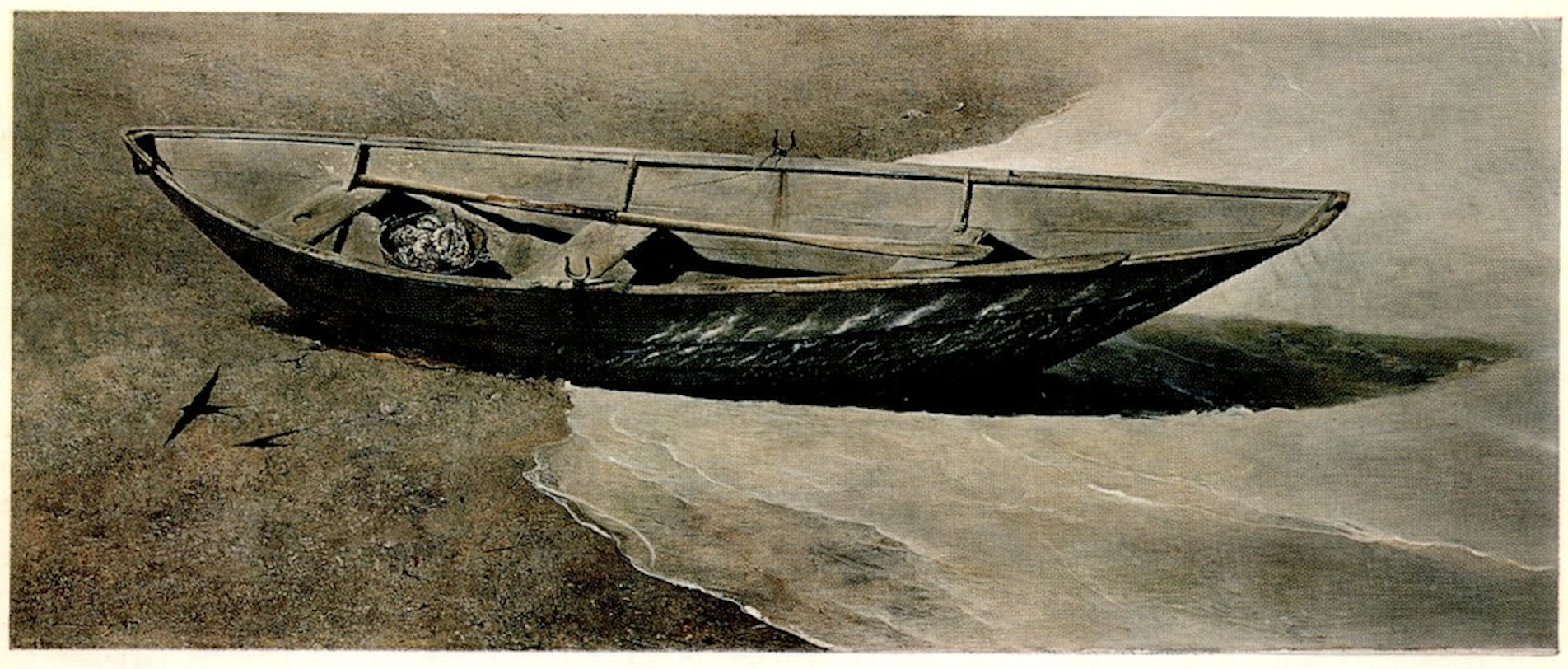
In the reproduction, the skiff appears as a wooden vessel with a large flat bottom, rowing oars, and a simple galvanized bucket stowed on board. The bucket holds what appears to be a fishing net ready for use. However, the boat’s paint is faded, and a broken cord is tied to the rowlock. As the only subject in the painting, my eyes move from the aging skiff to a sandy beach, down to a shadow cast in the sand by a seabird, then back to the boat. I drift through the painting just as my imagination drifts out to sea in the skiff with a man, boy, or family along the coast. The image of the empty boat sticks with me as we eat and remains with me even after we return home. The solitude depicted in the print filled a space in my imagination until I recently read The Old Man and the Sea by Ernest Hemingway. After finishing the novel, connections began to emerge between the painting, the novel, and the coast of Virginia; a trifecta of ideas came together in my mind.
A fiction writer friend suggested I read more of Ernest Hemingway, since we share a love of the outdoors. He also suggested I might find his Iceberg Theory of writing interesting. Hemingway suggests that a book’s dialogue and action should allude to underlying emotion and meaning rather than letting characters explain it directly. That readers should be active participants in the experience of creating the story. He suggests that in an excellent book, 80 percent of its meaning lies in the lower half of the iceberg, hidden beneath the water’s surface. A place full of dark symbolism and unusual subjects. At the same time, the visible portion of the story, the actual written words and dialogue, is only the top 20 percent of the iceberg. After reading The Old Man and the Sea and viewing Spindrift, I believe both works follow a minimalist style and engage the reader or viewer in the 80/20 Iceberg Theory that Hemingway suggests is so important to good storytelling.
As I continued reading Hemingway’s Nobel Prize-winning book, I realized how sparse Hemingway’s settings are and found myself focusing on the skiff, the old man, and little else. The author’s description of the boat, along with Santiago’s rustic home, feels very familiar as I finished reading. So familiar that I had to look up Andrew Wyeth’s boat paintings on my laptop. In my imagination, Santiago’s boat and shack were similar to Wyeth paintings that I had fallen in love with years earlier. What I found surprised me, and as I looked more closely, I realized the novel and the painting were produced in the same era. With Hemingway winning the Nobel Prize in Literature in 1953 for The Old Man and the Sea, and Wyeth finishing the Spindrift painting in 1950. Yet, I felt other unusual connections between the two.
After reading about Santiago’s adventure, I felt that Hemingway’s character is haunted by dreams of better days and younger adventures. In the same way, Wyeth’s empty boat felt haunted by an unknown future and loss of adventures. Wyeth, like Hemingway, wants to make the viewer or reader an active part of the work’s meaning.
As I reflected more, I began to notice an undertone of emptiness in both the painting and the book, creating a sense of being merely a shell of a former self. This feeling of emptiness is not just about age, but also about the fact that both the old man and the skiff are being bypassed by time. The beached boat and the old fisherman don’t show vitality and strength but rather weakness and frailty in this context. These deeper themes appear 80 percent below both the stories’ and the paintings’ surface, just as Hemingway suggests. Both artists expertly evoke sympathy for their subjects as they face the battle between old and new, and the conflict between usefulness and inadequacy.
Both Wyeth and Hemingway are stark in their world-building, benefiting both viewers and readers. Their minimalistic style focuses our attention on what is presented without the distraction of too many details. We are intentionally guided from place to place and scene to scene. We feel the weight of emptiness in both the skiff and Santiago’s life. Wyeth also imbues his paintings with the muted colors of the beach and sea. He uses shades of gray, sandy yellows, browns, deep greens, and blues, limiting our emotions by excluding any bright, excited colors. Hemingway also concentrates only on the sea’s colors and those of the marlin that Santiago catches. It is the dark greens and blues of the water, along with the fish’s silver and lavender skin in his scenes. As readers, we do not see the brilliant sun or the crisp blue sky. We imagine the sea’s darkness and the elegance of the fish’s silvery skin, and Santiago’s love for both.
It seems that both Wyeth and Hemingway are drawn to these subjects and stories that reveal deeper feelings about their lives and the changes coming at the end of the 1950’s. Whether it was intentional, as Hemingway suggests, or just a beautiful still life that Wyeth found intriguing, it’s powerful how each artist leans into saying less to convey meaning.
After my husband and I leave The Pearl restaurant, we roam the shops along the breezy streets of Chincoteague Island. Along the street, we pass several docks behind sun-bleached houses on the inlet side of the island. These community docks are lined with dozens of small fishing boats moored and resting in the seagrass and tidewater. Some boats look new, with nets drying in the evening sun. Others appear worn, with chipped paint, missing nets, and some may be abandoned. The smallest wooden dories, used for inland waterways and coastal fishing, sit on the sandbars and beaches near the houses. Sometimes a dory rests on sawhorses where a fisherman has started repainting the hull, while other times they lie tipped to one side, filling with beach sand. They all look very similar to the Wyeth painting in the restaurant, and there is something beautiful about the empty boats and the life of a fisherman that I can’t resist.
Reflecting on our evening on the Island and my first encounter with the Spindrift image and the life of Santiago in Hemingway’s The Old Man and the Sea, I realize that I, too, am haunted by the past and ways of life that are fading away. I believe it’s because I enjoy examining things that seem to have little value from the outside, like old buildings, worn boats, and broken-down vehicles. But when you look closely, you often discover something surprising inside. It is the same moment of wonder I experienced when I discovered the depths of Hemingway’s novel and Wyeth’s painting, and how much of their brilliance is just below the surface of the water.
JoLynn Powers is a long-time resident of West Virginia and a graduate of West Virginia Wesleyan College’s MFA in Creative Writing program. Her passion is writing essays about the people of Appalachia, her family, and the beauties and struggles of her home state.

