by Sally Brown
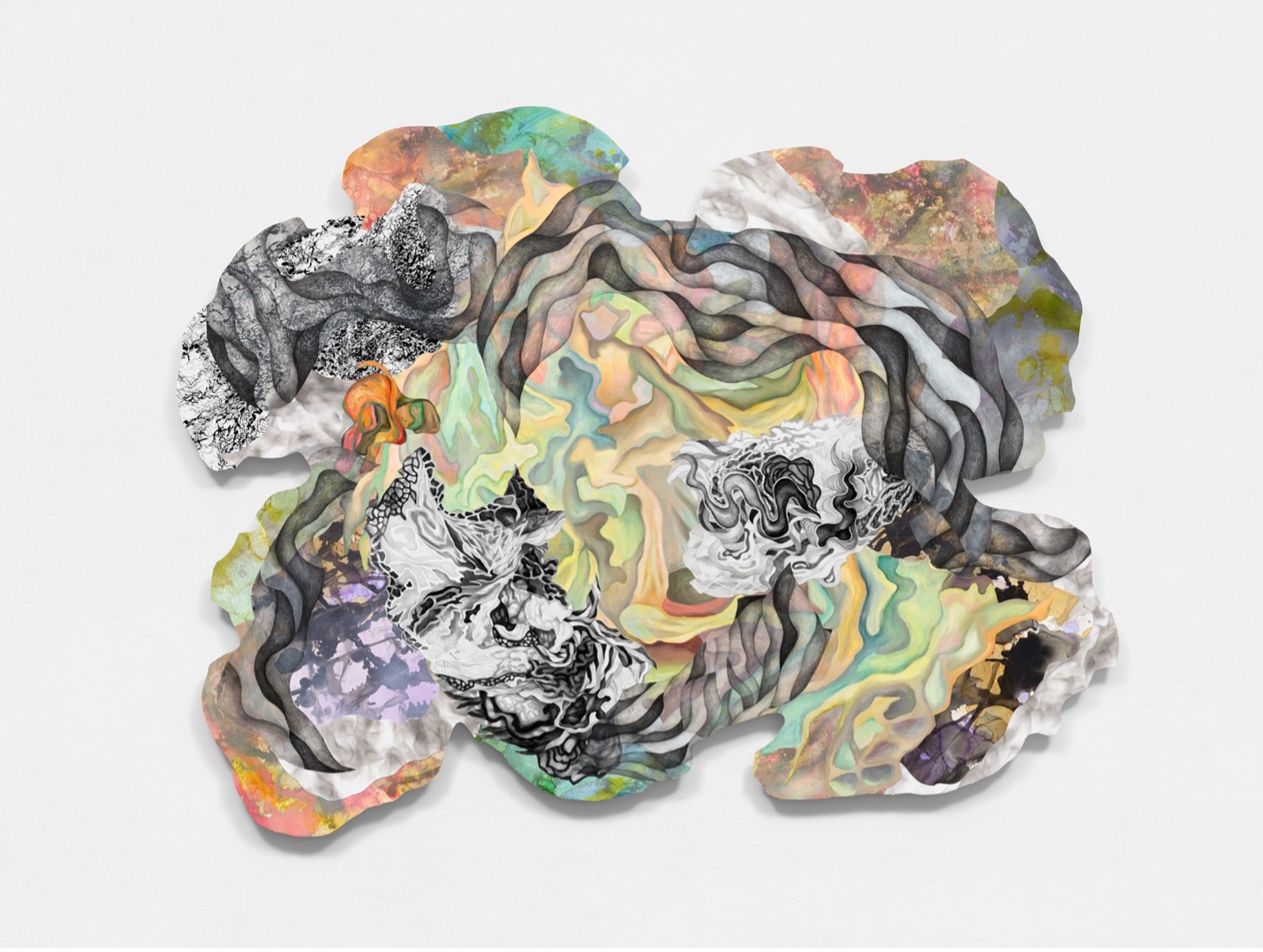
I found Holly Wong’s Lamp of Memory 1 late at night, scrolling through her website. For some reason, this piece stopped me. Not because I understood it, but because it felt familiar, bodily.
The form floats against white space, irregular, clouded, more grown than built. Grayscale textures press against coral, mint, yellow, and slate. Some areas feel compressed, sedimentary; others spill like liquid. My eyes wander, searching for a resting place, but the image doesn’t allow it. It moves like memory, or thought, bodily or otherwise.
At the same time, I was rereading Renée K. Nicholson’s poem “Curtain Call” (from Post Scripts, 2024 Wild Ink Publishing), which opens: “The pain behind the patella radiates / like light through a diamond.” That line landed physically; It named aches we all know. Ordinary pain, folded into daily life until someone names it, and suddenly it glows.
The poem moves through the body in transit: knees twitching on buses, breath frosting in cold air, the speaker scanning a northern city for traces of home. Memory folds into infrastructure. Body folds into place. The poem doesn’t resolve. It keeps moving.
Wong’s collage does the same; no anchor, no hierarchy. Layers accumulate in heavy grayscale, bursts of color, pressure, and fluidity. It feels mid-becoming, dissolving, remembering.
Seeing the poem and the collage together changed how I experienced both. The grayscale folds began to feel like connective tissue; color radiated like sensation. The poem’s buses, lampposts, dance halls, and grocery stores became texture, a space I moved through rather than a path I followed.
Both works resist closure. “Curtain Call” ends with departure, not resolution: “your last stop, that lamppost where you depart.” Wong’s piece refuses tidy meaning as well. Grayscale meets color, density meets fluidity. It’s ongoing.
As someone whose own work circles bodies and memory, I am drawn to how both Wong and Nicholson handle such sentimentality. No redemption arc, no glow-up, no transcendence, just attention, precision, care. Pain is neither hidden nor aestheticized. It is located, lived, felt.
In the poem, pain becomes luminous; in Wong’s collage, density becomes color, pressure becomes pattern. Neither offers escape from the body, but both invite inhabiting it more fully. Memory isn’t stored. It moves through joints, streets, pigments, folds of gray. It accumulates, compresses, spills, shifts.
Sitting with Lamp of Memory 1 and “Curtain Call”, I am reminded to stay with sensation, to listen to my own body, to let memory be messy, and to keep moving even when nothing resolves.
Memory isn’t something we hold.
It’s something that holds us.
Sally Jane Brown has exhibited her work nationally and in the UK. She has won several awards and four artist residencies. Her art and writing has been published in Women’s Art Journal and Artslant, among others. She has curated group shows nationally. She serves as a Curator for West Virginia University Libraries. Sallyjanebrown.com

