by G. Sabbatini
Sometime in the late 1970s, my Italian grandmother, a lifelong student of the arts who immigrated to the United States as an adult, was shipped a crate of antique furniture and paintings from Naples. The passing of my great-grandmother led to a nonsensical division of the family’s art collection, angering my grandmother, the eldest daughter excluded from the negotiations and sent into mourning twice over. My grandmother passed away when I was a child, and there has been virtually no communication with our extended family since. Yet what remains of her—a bust of Nefertiti on my desk, marginalia in beat-up paperbacks, and the paintings—fosters a posthumous getting-to-know-you between granddaughter and grandmother, as precious as the few memories I retain.
Because of poor recordkeeping, I will likely never know what the art collection looked like in full. The eleven remaining paintings (mostly oil on canvas) sit today in my parents’ home on white-painted bookshelves whose display lights are rarely turned on. As I conduct slow research, I rely on my father’s limited memories and a handful of Polaroids tucked inside an old safety-deposit box. Tracing artists’ biographies across the landscapes my ancestors traversed initially felt fruitful. Now, it seems time to let the images speak for themselves. I can only hope that time spent with the paintings will ground me in my ancestral roots, initiating a sense of connection to those who came before me.
Two years into my increasingly obsessive relationship with the paintings, I was given a book that changed everything. Before reading W. J. T. Mitchell’s What Do Pictures Want? (2005), I had imagined the paintings in dialogue with each other and with the couple who purchased them. Through old photographs taken by my grandmother in Naples, I could see them decorating pale walls in the background. But even this glimpse lacked the intimacy I craved. Relegated to the corners and backgrounds of overexposed photographs, the paintings resisted interpretation. What I failed to realize before reading Mitchell was how these images connect past and present. Like a good therapist, What Do Pictures Want? encouraged me to focus less on what I lack—my grandmother’s thoughts and the paintings’ full provenance—and instead allow the images to speak directly, articulating their own desires and what they themselves have witnessed.
As in most families, there is always one member who seems unlike the rest. It does not take an art history degree to see that one image in this collection divorces itself from the others. This painting, which I have privately called Temptation for the last decade, is an outlier for many reasons, but above all because of its ability to arrest its beholder through its projection of desire. For Mitchell, and now for me, such “images introduce new forms of value into the world, contesting our criteria, forcing us to change our minds…Images are not just passive entities that coexist with their human hosts…they change the way we think and see and dream.”
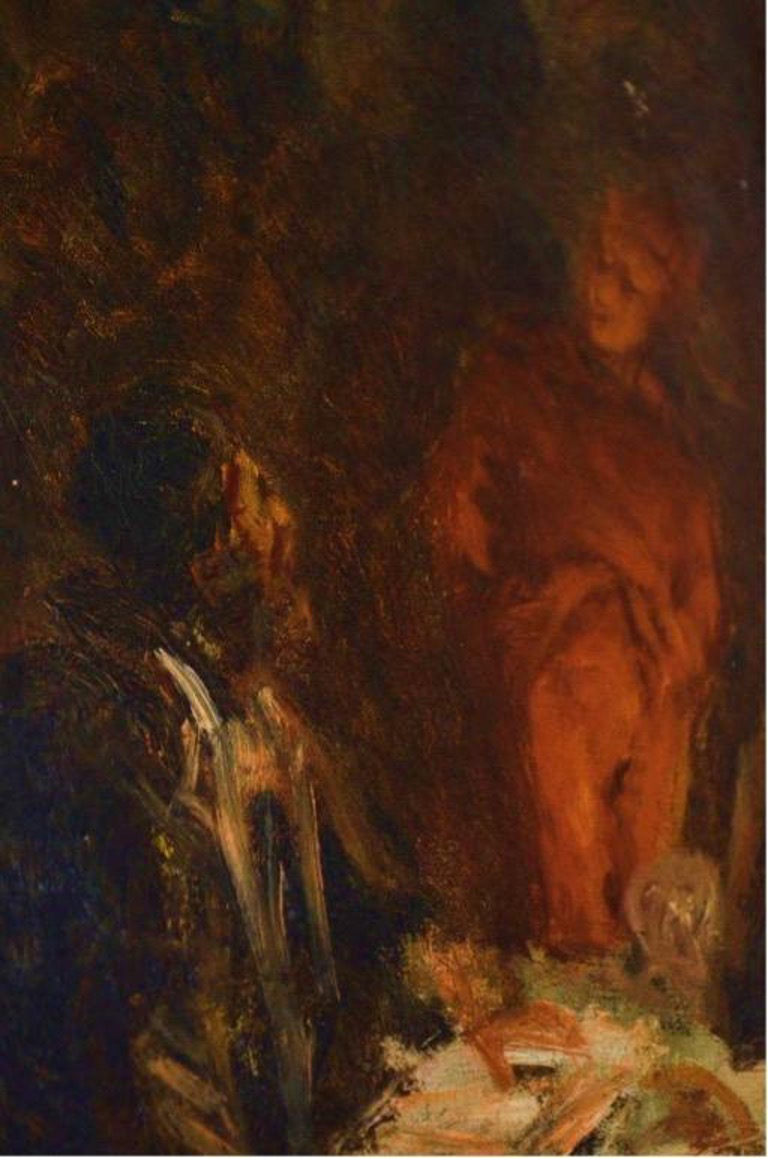
I have chosen to call this painting Temptation for several reasons. Its uncanny ambiguity and seductive abstraction are formative to my writerly interest in the consumption of images. Its subject matter suggests provocation: it draws the viewer’s gaze so insistently that attending to the other paintings becomes difficult. At the very least, Temptation introduces a darkness into the gallery that reshapes how the surrounding portraits and landscapes—each easily attributed to known artists—are seen. This painting is devoid of signature, lacking the usual markers that have made my research into the other artworks bearable and led me to feel as if I was making progress towards something that felt concrete or traceable or even real. Despite its enigmatic frustration often leaving me flustered and near exhaustion, Temptation retains the greatest pull, inviting curiosity the others cannot sustain.
This absence of identifiable markings makes this painting the most expressive, the most capable of revealing desire on its own terms. Temptation craves prominence; it demands to be taken seriously those who favor conventionality and feel uncomfortable in the presence of the unknown. In negotiating absence and presence, it can arrest even the most uneasy viewer. Temptation tells you it can transcend the realm of the picture and enter the realm of the living. The question is whether the viewer will let it.
Temptation is a painting of two figures: a man gaping at what I call the devil-figure, who stares back at him so intently, yet so calmly, that it becomes nearly impossible to imagine its fixation on anything or anyone else. The devil holds the panicked yet numbed man in a trance, dissolving time and space. Though the painting has hung in family homes across two continents for over a century, the man remains frozen, unaware of the generations that have observed their exchange. Neither figure meets the beholder’s gaze. Yet this inwardness does not exclude the viewer; rather, the painting introduces a fourth presence that complicates this scene.
An out-of-frame light source illuminates the devil, projecting a shadow upward and creating a pyramidal composition. Because the shadow lacks physiognomy, the beholder cannot lock eyes with the only figure capable of looking outward. Those who fail to notice it miss the painting’s engagement with the world beyond the frame and with the family history it carries. If the silhouette stands for a more powerful entity, the composition suggests a hierarchy: mortal man below, Mephistophelean intermediary in the middle, and a dominating oversoul above. The shadow implies the devil is itself a pawn. Mitchell, too, ruminates on the silhouette: “Drawing, like photography, is seen to originate in the ‘art of fixing the shadow.’ The silhouette drawing, then, expresses the wish to deny death or departure, to hold on to the loved one, to keep him present and permanently ‘alive.’” This is precisely how the silhouette functions in Temptation: the man is indelibly arrested in a moment that transcends time, permanently alive within an inescapable purgatory. The painting’s fixation of presence recalls my relationship to my ancestors; though they cannot answer me, they have not fully disappeared from the realm of the living.
Viewers who pause to identify the red devil offer varied interpretations; several male visitors have suggested that the figure is a woman, possibly even the male figure’s wife, desiring to punish her faltering husband. How does such an interpretation alter the image? As Mitchell explains, “The whole anti-theatrical tradition reminds one again of the default feminization of the picture, which is treated as something that must awaken desire in the beholder while not disclosing any signs of desire or even awareness that it is being beheld, as if the beholder were a voyeur at a keyhole” (44). Feminization of this image is most likely to occur when viewers fail to notice or acknowledge the presence of the ungendered silhouette, the form that discloses the image’s desire to the world beyond the frame. Such feminization attempts to negate the image’s desire; however, desire cannot be stripped from an image that possesses more life than its beholder might be capable of acknowledging.
Mitchell also argues that the vitality of an image is independent of its value (90). Temptation confirms this within my family’s home. It is often considered the least pleasing work because its gloomy palette and unsettling subject jar against landscapes, Madonnas, and portraits of young girls—figures that, legend has it, depict my great-great aunts. Yet the painting suggests the possibility of revival within its darkness. The man appears poised between death and survival, dependent on the devil’s intention. Still, this image, and consequently the vitality of the male subject, can only be displayed in the light if its owners deem it worthy of such exhibition.
This painting will remain confined to the familial gallery space, at least for now. To take Temptation seriously is to gratify its desire; however, the painting isn’t the only beneficiary in this exchange. The beholder is, too.
G. Sabbatini writes poetry, fiction, and essays that investigate creative mythologies and cultural memory. Her work explores the stories we tell about art, artists, and their afterlives. Learn more at gsabbatini.com.
 After the Art