by Joan Boxall
Henry Moore’s Reclining Figure 1951 hit me in all its plaster-and-string splendor. I first stumbled upon it while touring Tate Britain in September of 2022 and again this past summer of ’26.
The female figure appears to tilt back, as do two-thirds of Moore’s sculptural works, but not in repose. The plaque beside it states that it was “Moore’s original plaster from which was cast the bronze sculpture commissioned by the Arts Council for the Festival of Britain in 1951 [and that] Moore held this particular sculpture in high regard, describing it as ‘perhaps my first sculpture where the space and the form are completely dependent on and inseparable from each other.’”
That two of the seven art elements infuse each other moves me. People are drawn to artful elements. We sometimes put on an elemental cloak for its colour, form or line. The element gives us meaning and identity. We rub off on each other.
My husband and I joke that we embody “space and form.” He loves open spaces, and I am shaping life experiences into my own 3D form. Most works contain two elements on the colour-form-line-shape-space continuum.
Henry Moore said how difficult it was for him to capture 3D-form. The element of space enables form to have depth. Reclining Figure 1951 puts those two elements in perfect symmetry.
“The hole became as important as the shape,” Moore said in a Getty Images recording where, in his soft-spoken British accent, he recounted how he came to understand 3D reality in “steps and stages.”
His seven-decade career directly carves a path in the subtractive method that Michelangelo called removing “everything that is not David.”
He “turned” his ideas into sculpture. He used found objects like a large bone (a “sculptural object” according to Moore) and revolved it slowly on a turntable: “It has such variety…and yet such strength…it’s really the same object and the same rhythm, but things happen that make you discover entirely new shapes as you look round it,” he said.
Many round-about views of Moore sculptures are available online—some with musical accompaniment. YouTubers enjoy filming them, wherever the 389 of them are found in 39 countries, according to a 2025 “Henry Moore Studios and Gardens” post. Moore situated hundreds of his pieces outdoors in natural settings. We saw them at his home studio in Perry Green, Hertfordshire and let them rub off on us. Once back at London’s Tate Britain, I walk around it the way so many have done.
Deliberate upon this description by art experts, Beth Harris and Steven Zucker[1], in which they concur that this is not only a human body but also a landscape:
Consider the spaces … the giant cavity…where we expect to see a torso … curvilinear forms. The dirty ivory feels organic (like bone) … missing feet and hands … one can’t be too literal when the negative space feels just as substantial (in the sense) of lifting up … almost like a landscape or a figure on a beach. I have a feeling like when I arch my back … there’s tension there.[2]
I took three stills in my round-about:
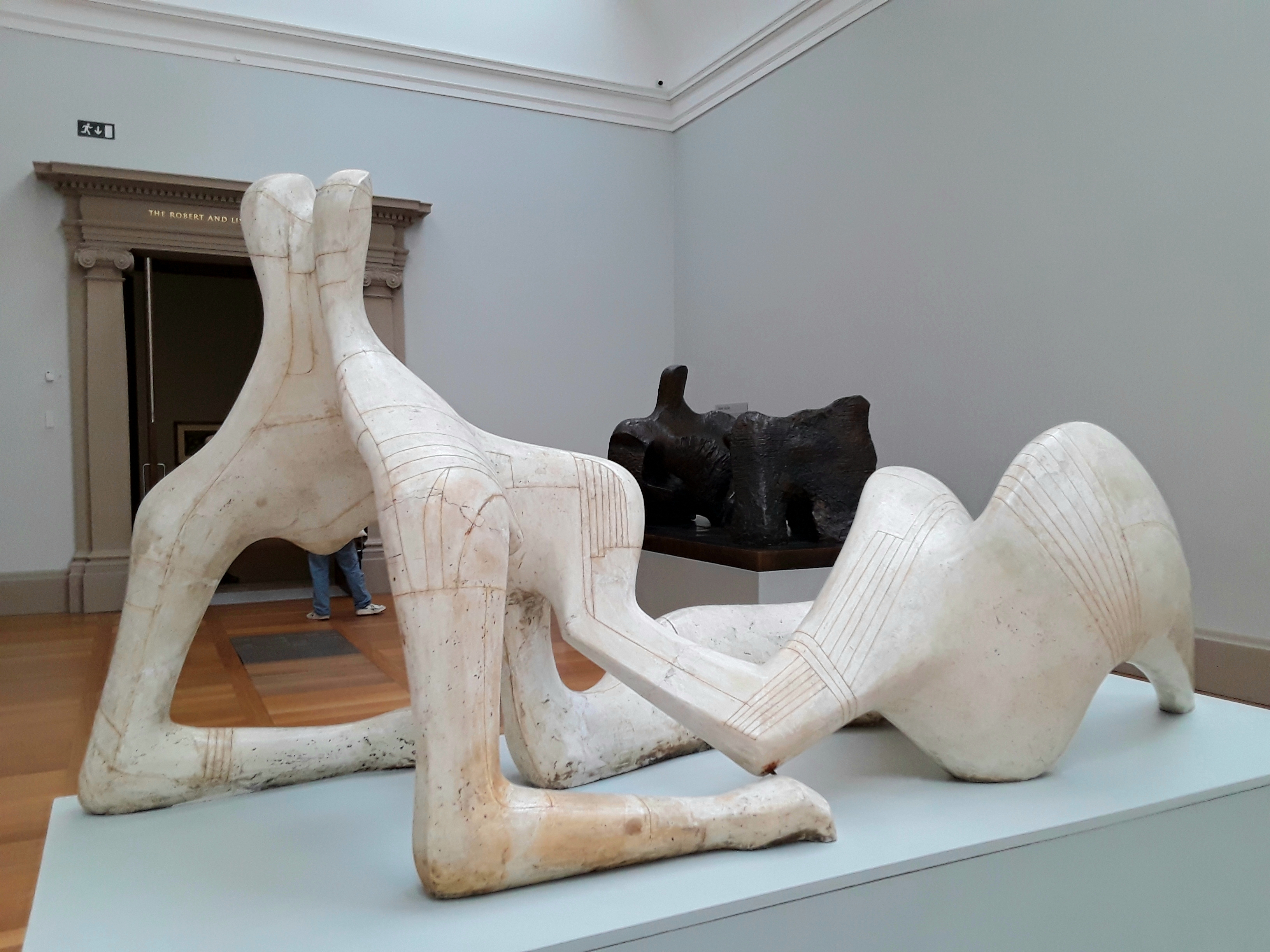
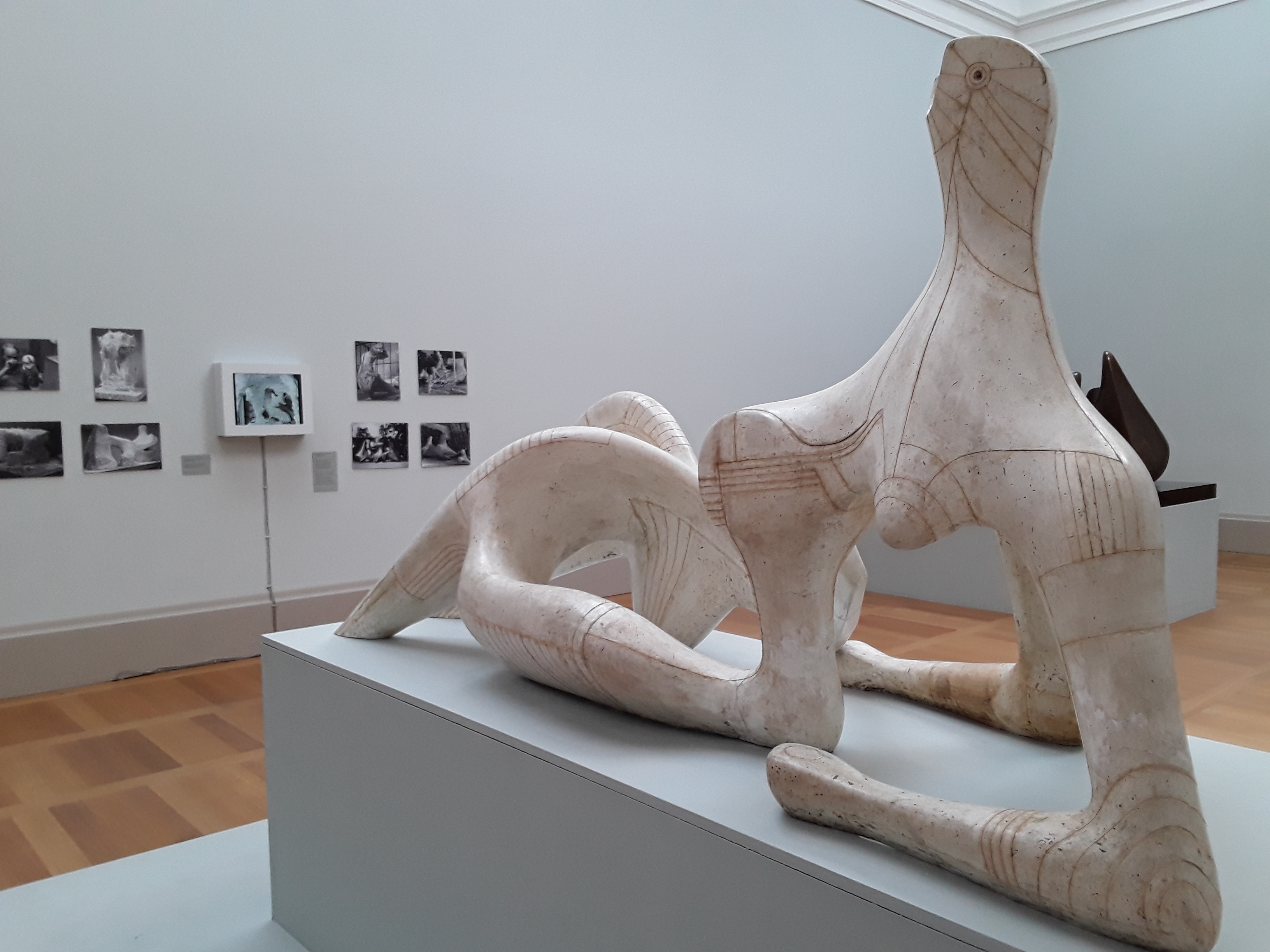
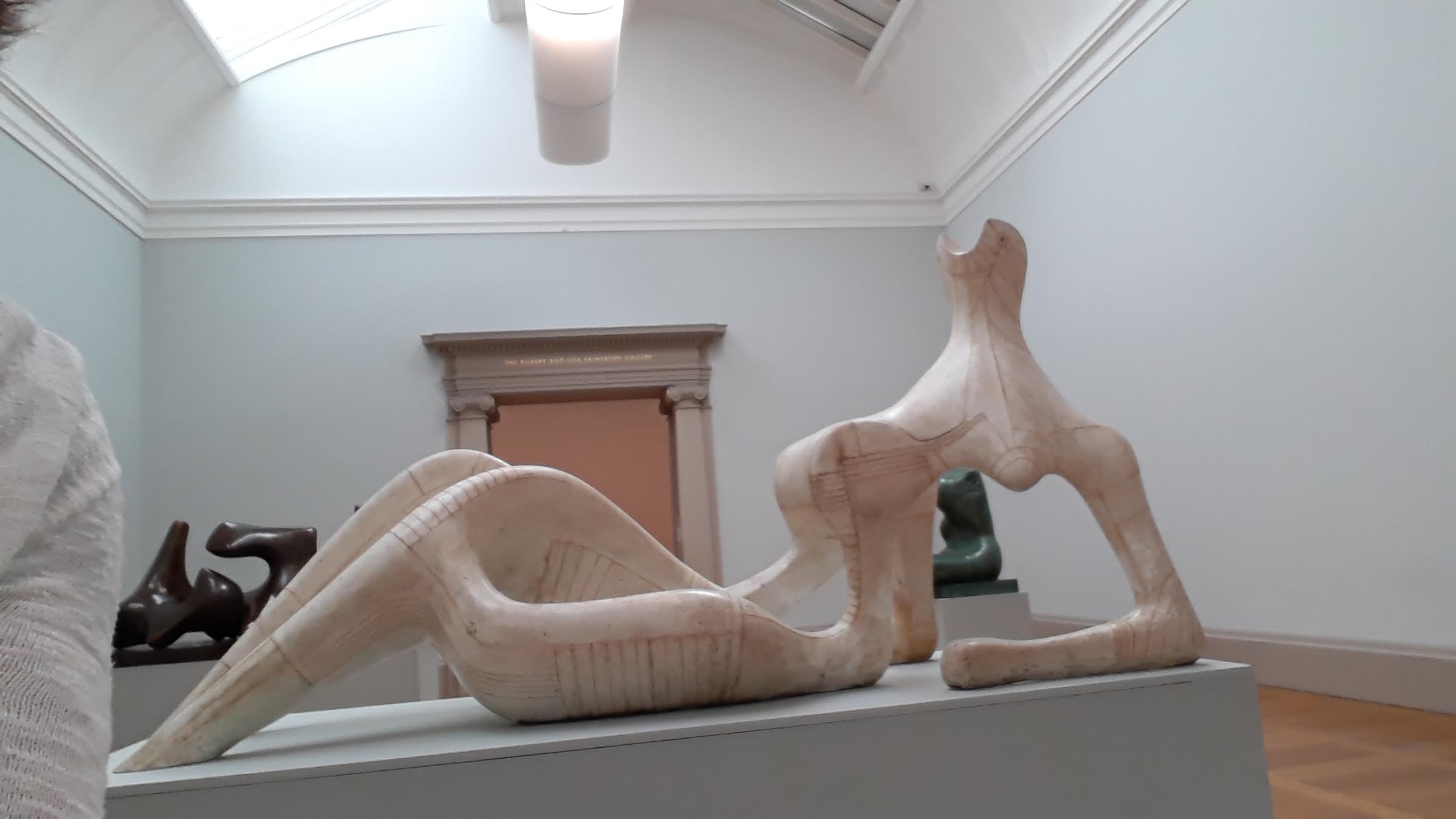
The embedded strings create the element of line in simulating fingers and toes. They invite the viewer to imagine the missing parts, to “fill in the gaps,” to duplicate body parts like hips and breasts.
Less than a year after viewing this resplendent reclining figure, I pick up a slim novel, All the Colour in the World by CS Richardson. In it, a character named Henry finds boyhood solace in art and becomes an art historian. This fictional man lives in Toronto (as does the author who was a book designer for 40 years). Henry, the character, becomes a soldier in WWII Sicily.
Henry Moore, the artist, convalesced from a mustard-gas attack in France in 1917. The character of Henry suffers the tragic loss of a beloved, and then another wartime tragedy unfolds, until his final redemption.
CS Richardson says, “Art is a lot more powerful than you think it is… it can be a vaccine. It can soothe the troubled soul. It can get you through bad times, it can get you through great times — it’s a memory palace. It’s all of those things.”
Henry Moore did over 9000 drawings, and let his WWII War Artist observations inspire future works in wax crayon and watercolour like Tube Shelter Perspective: The Liverpool Street Extension from the era of Blitz Britain. Less than a decade later, Reclining Figure 1951 bears a resemblance in the reclining posture and chalk-like rendering.
I sit up from my recliner, no longer in repose. In steps and stages, I am filling in the gaps on my very own 3D work in a roundabout way.
Joan Boxall is a poet, blogger, travel writer and author.
In 2019, her memoir was published by Caitlin Press and illustrated by her brother, Stephen Corcoran: https://caitlinpress.com/Books/D/DrawBridge. The sister-brother duo participated in weekly figurative drawing sessions for nearly a decade, before Stephen’s death in 2013. The process drew out her isolated, mentally-ill brother, and her artistic craving.
She is working on a second memoir entitled, In Her Element: Visual Art Becomes Us.
Read more on her blog, ‘I’m Not an Artist, But…’ at https://www.joanboxall.com/.
[1] https://smarthistory.org/staff/
[2] https://www.khanacademy.org/humanities/ap-art-history/start-here-apah/why-art-matters-apah/v/describing-sculpture-henry-moore

