by Craig J. Saper
One day I visited Amsterdam’s Rijksmuseum very early in the morning intending to take pictures of people desperately trying to be first in line to look at paintings. Most of the tourists were huddled in dense crowds around the small unexceptional Vermeers (although the super-fans think the painting of the milk maid should be on our bucket list).
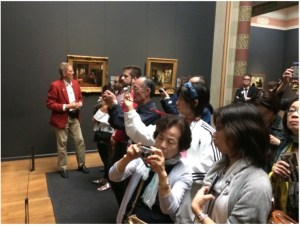
To the suspicion of the museum guard, for me the crowds were more interesting than the paintings; how funny that we all seek to capture these images in a digital form when they are seemingly infinitely available in that form with the click of a button; prints sell for a few dollars on Etsy. Around the corner without the crowds, was a fascinating Johannes Jelgerhuis oil painting depicting, in minute realist detail in the tradition of the Golden Age of Dutch painting, a scene set in a book and print shop: the Bookshop of Pieter Meijer Warnars (1820).
It drew my attention because it was a window onto an era when publishers were not yet industrial corporate entities, and bookshops were important places. Twenty-first-century eyes can easily miss the small wooden printing press, a book stretcher and other tools arrayed in the middle of the floor, and one might also not spy the owner of the bookshop perched at a desk writing with a feather quill pen, as he is tucked away in the front corner of the store surveying both the street scene outside and the magnificence of his shop. One barely notices anything except the books: the many shelves of books fill both sides of the painting from the floor to the border of prints next to the ceiling. The mass of bound books overshadows everything else including the people in the shop and draws the viewers’ eyes to the reason for the painting: to show off the merchandise and its importance at the centre of the city’s cultural life.
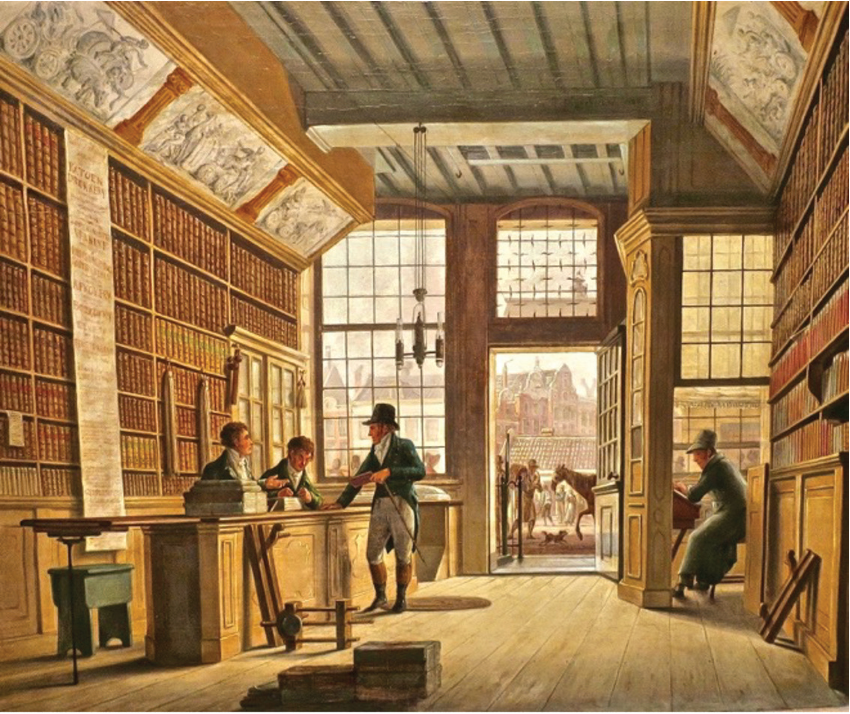
It is a grand oil painting, commissioned by Warnars (1792–1869), a wealthy figure in Amsterdam’s high society. Although he inherited the prestigious publishing house and bookshop from his father, Warnars continued its success and influence. A twenty-first-century audience might greet the mundane realist scene glorifying a bookshop with quizzical bemusement because most of the surrounding paintings in the Rijksmuseum’s galleries portray political leaders, battle scenes, religious allegorical scenes or a demonstration of great skill in the art of still-life paintings of flowers, Flanders, now Belgium.
The contemporary Rijksmuseum curator’s description finds it necessary to explain that “Amsterdam’s cultural elite met up in this book and print shop.” A book and print shop’s importance in 1820 now needs an explanation and justification! It is likely that now many younger spectators of this painting have never visited a bookshop that did not also serve as a coffee shop or a place to buy knick-knacks and sweatshirts, let alone comprehend a bookshop’s crucial importance in the cultural life of a major cosmopolitan city. From our contemporary perspective, books, publishing houses and bookshops were then of almost inconceivable importance, and Warnars’s company was one of the most important on the European continent. P. Meijer Warnars published patrician romantic adventures and histories, such as the two volumes of Legends of the Netherlands in 1828, as well as English romantic stories and poetry, especially George Gordon, Lord Byron’s poetry such as the tragic historical drama The Siege of Corinth, to which the Dutch, having only recently escaped from the French siege of their lands, could sadly relate. In general, Warnars favoured stories that advocated royalist and nationalist tendencies. During the first half of the nineteenth century and depending on the national circumstances, publishers such as P. Meijer Warnars often established books and book collecting as a romantic aristocratic and aesthetic endeavour, the publishers as cultural knights enlightening readers with universal ideals and the romance of nationalist histories.
Although books were a valuable and “standardized medium of exchange” at least throughout the eighteenth century, it was still an aristocratic form of symbolic capital ultimately legitimated by royal courts’ standards; the industrialisation processes made mass markets the key to economic value, and the literary value supplemented the marketing of a product. Publishers of ephemera such as newspapers, broadsides and pamphlet-length tracts had other political goals and a more standardised typography, layout and design, but they sometimes included playful typographic or design experiments to attract readers’ interest. Newspapers and magazines flourished with industrialisation, and those forms seemed better suited to the media corporation than the independent publisher seeking to produce the well-made book.
Focusing on the representation and images of publishers, Warnars fits into the tradition established by a long line of trader-publishers starting with William Caxton, the first English publisher-printer, who lived in the early and mid-fifteenth century and began a printing and translating trade in Bruges (or Brugge, in Flemish and Dutch) in West Flanders, now Belgium.
After working as a successful mercer, trading wool, luxury goods and illuminated manuscripts, and as a governmental administrator for the English in the Low Countries, Caxton became a stationer, and in that role he also started publishing and often printing books; even though he was also the translator of the books he printed and published, he is not known or even remembered as an author or translator. The lasting importance of these books and Caxton’s name reside solely in the history of publishing; he is now celebrated for publishing the very first book in the English language, The Recuyell of the Historyes of Troye (1474), and he is most famous for the first edition of Chaucer’s Canterbury Tales (1478); this was a welcomed if radical publication because publishing in English, a language spoken by people in everyday life rather than the Latin of officialdom, highlighted how a publisher with a very small staff could speak directly to a reading and book-buying public, even if they were mostly aristocrats.
Further suggesting the power of his individual press versus the emblems of church, state or royal family crests, Caxton’s unique publisher’s device (that he started using around 1491) includes his initials on either side of a fifteenth-century Gothic cursive ‘74’, to allude to the date of his production of the first English book mentioned above. This device, as part of the early lineage of these devices, marks not only Caxton’s individual business but also the continuing emergence of capitalism, the rise of the bourgeoisie, and the importance and rights of individuals in these new forms of social organisation. The publisher’s device functioned as a concrete emblem of publishing’s very new centrality in all these emergent changes in the organisation of society, as well as the peculiar importance of books,reading and print literacy in this form of modernity. These changes usually thought of as an immediate sea-change is now understood as more tidal than rapid; it depended on what James Raven explains as the breaking of an earlier economic regime that had allowed only low productivity rates and had demanded a particularly high level of labour intensity. The fundamental enabler of this revolution in production volume [. . .] was the invention of mechanised printing and mechanised papermaking, even if this was no overnight process. [James Raven, The Business of Books: Booksellers and the English Book Trade, 1450–1850 (New Haven: Yale University Press, 2007), 325.]
Looking back to a time before the industrialisation of publishing paints a picture of the dramatic and relatively rapid changes to the status and cultural function of the publisher’s art. In a matter of five decades, the role of the individual publishers began to move from serving as elite cultural leaders among the mainstream, and often in league with church and government establishments, to experimental or avant-garde goals who were sometimes in trouble with government censors. The changes from 1820 to 1920 seem slow and quaint compared to what we are experiencing in the 2020s in the transition from print-literacy and close-readings to bots and big-data hacking us into bits and bytes. We might see a return to the slow and analogue in tiny free libraries, wandering away from the museum’s docent, and spending an hour staring at a more than 200 years old painting in a museum.
Back in the Rijksmuseum, when I discovered the depiction of Pieter Meijer Warnars’ Bookshop, and spent the next hour studying it and also intermittently moving on only to circle back to it to see if anyone was standing there looking at it (they were not), two thoughts came to me: I should tell others to come look at it and also I should keep it a secret, my secret entrance to Warnar’s bookshop in the 1820s. This essay is one way I can do both.
Craig J. Saper writes about small press publishers, networks of printers and artists, book arts, visual poetry, experimental reading machines and art stunts. His recent books include: Auteur-Publishers: Small Press Practices as Avant-Garde Writing; Readies for Bob Brown’s Machine; The Amazing Adventures of Bob Brown; and Intimate Bureaucracies. He recently took a workshop in letterpress printing at the Baltimore Print Shop.

