by Kimmo Rosenthal
The Australian author Gerald Murnane has a fascinating description of reading: “The truth of … reading is … the self-evident fact that there is no reader nor subject-matter, only images and feelings in a sort of eternity.” The true test of a text for me is whether or not I become immersed in these feelings and images, which evolve from, yet transcend, the words. At that point, I, the reader, begin to take ownership of the text. Murnane further exhorts us to “accept as truths only the findings of your own introspection.”
When I contemplate paintings, I find that my impressions are often described by the above whereby I replace “reading” by “viewing” and “reader” by “viewer.” This is never more apposite than when looking at the work of Edward Hopper. The phrase “sort of eternity” reminds me of the observation by the art critic Richard Lacoyo describing Hopper’s works as “emblems of eternity.” Hopper’s paintings conjure the feelings of melancholy, loneliness, and, when they contain people, the experience of isolated humans – isolated even when with others – confronting their fraught existence. Lacoyo describes his work as “nuanced realism,” yet there is something uncanny about many of the paintings. The mundane and familiar are imbricated with the extraordinary and otherworldly. One of the first paintings that I became fascinated with, hoping to find its “truth,” that is to say its “truth” for me, was Early Sunday Morning. I found myself imagining the lives of the inhabitants behind the sad yellow-curtained windows leading lives of quiet desperation, to quote Thoreau, with their all-too-fleeting moments of happiness, looking toward the wavering haze on a horizon that stretches out to infinity.
Over the years I find myself regularly returning to Hopper’s work and one particular painting, People in the Sun, has always intrigued me.
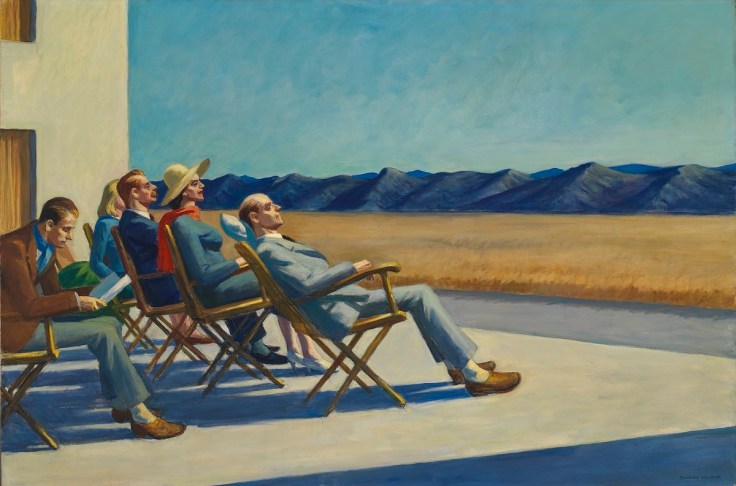
Although Hopper expressed disdain for surrealism, there is an element of the surreal in its landscape. Three men and two women are sitting in lounge chairs on a concrete patio in front of a building that seems situated in the middle of nowhere. There is a narrow strip of paved road and then a long stretch of brownish grassy plains with some ominous looking, purplish mountains on the horizon. These people seem the antithesis of a group ostensibly relaxing in the sun. The men are fully dressed in suits, albeit without socks, with the women dressed more for the theater than for sunbathing. They all appear as if teleported to these chairs from elsewhere. This absurdist presentation might be the opening scene from a late-period Beckett play set outdoors. Hopper rarely has people facing the viewer and here their mask-like expressions suggest mannequins propped up in chairs with an empty stare out towards another wavering haze on the horizon. There is a sense of profound unease, if not confinement, in spite of being outdoors. Although part of a group, they sit impassively with no interaction. And what to make of the one man to the side of the others reading a book? The prevailing mood is one of sunlight and silence (what Lacoyo refers to as the Hopper constants), accompanied by an eerie strangeness. The prosaic title People in the Sun belies the mystery of the painting; a more fitting title might be Enigma in the Sun.
It was fortuitous happenstance that had me reading Lacoyo’s chapter on Hopper while simultaneously rereading a collection of essays, Gerald Murnane: Another World in This One. I realized that the exegeses of the themes and ideas of Murnane provided a roadmap to understanding the mysteries of the painting, as some thoughts began to emerge from the mists of uncertainty.
Landscapes occupy a central role in Murnane’s work, as he envisions the mind as a “place of infinite seeming landscapes” most often represented by grassy plains. This mindscape, what he refers to as the so-called invisible world as opposed to the so-called real world, is the “another world” referenced in the title. In “The Plains,” he talks of one of the characters imagining “the places dreamed of in the landscape of her own heart.” Murnane espouses what he refers to as true fiction, where the narrator (or implied author) is reporting on the contents of his (or her) mind. I think of Hopper as practicing true painting, for Lacoyo quotes him as saying “I am trying to paint myself” and also that “the inner life of a human being is a vast and varied realm,” a quote that might well come from Proust or, in fact, Murnane.
Murnane discusses the reciprocal tension between “the vastness of what we are entitled to dream as opposed to the narrowness of what we are by nature likely to obtain.” The people in the sun seem incapable of dreaming; they are incapable of breaking free from the vicissitudes of reality; they are emotionally empty, locked into the narrowness of their lives. Wallace Stevens once wrote that “the world about us would be desolate except for the world within us,” and there is something desolate about these people, sitting immobile and affectless in their deck chairs, surrounded by each other, yet isolated; for them the invisible world of the mind is inaccessible, separated from them metonymically by the strip of concrete. The contrast between the so-called actual and the so-called possible is brought into focus if one looks at the right side of the painting. This Cézannesque landscape has the quality of openness and endlessness and, to use a word favored by Murnane, potentiality. Cézanne’s landscapes have been described as another reality looking back at us, and that is the sense here.
For me, the key to understanding the painting is the man off to the side reading a book, his presence a seeming incongruity. Lacoyo suggests he is a surrogate for Hopper, who was an inveterate reader, and it is interesting to compare this painting with Hopper’s Excursion into Philosophy. In it, a neatly-dressed man sits on the edge of a bed deeply absorbed in a book, oblivious to the naked woman lying behind him. Hopper suggested, perhaps ironically, that it is about someone discovering Plato late in life, but I think of it as turning one’s back on the visible world of emotions and desires to delve inward. The same feelings arise when contemplating the reader in People in the Sun. Reading invites introspection, opening up a realm in another world. It is a guide to unlocking knowledge and understanding of the self. Murnane speaks of “a space enclosed by words denoting a world more real by far than the visible world.” For many, the key to negotiating the ongoing struggle between our inner thoughts and the daily restrictions of our lives can be found in reading. I am reminded of William Gass describing a book as a container of consciousness. If truth is to be found only through introspection, as Murnane suggests, then reading is a means of unlocking the door to such self-reflection.
In his essay “The Still-Breathing Author,” Murnane recalls Proust advising a writer to “learn to read the book continually being written on his own heart.” I sense a commonality between Murnane and Hopper. Perhaps paintings like People in the Sun are expressive of Hopper using paint on the canvas instead of words on a page to learn to express what’s written on his own heart.
References
Gerald Murnane (Another World in This One), edited by Anthony Uhlmann, Sydney Studies in Australian Literature, Sydney University Press, 2020
Kimmo Rosenthal, “Tranquility Shot Through with Sorrow”, The Ekphrastic Review, February, 2019
Richard Lacoyo, “Edward Hopper – Into the Light,” in Last Light, Simon & Schuster, 2022
Kimmo Rosenthal, after a long career in mathematics, has turned his attention to writing. He has over thirty publications and a Pushcart Prize nomination. Some of his most recent work has appeared in The Fib Review, The Decadent Review, Hinterland, BigCityLit, After the Art, and Tiny Molecules.
 After the Art