by Gisèle Laffaye Pansze
Despite its steel-blue sky and mottled-saffron turf, the oil painting is unassuming, its dimensions approximating a hardcover novel. Tidy brushstrokes portray a scene from a polo match — not the sleek power of the modern professional game, but one played at the turn of the 19th century, judging from the sturdy ponies and the players’ uniforms (loose khaki breeches and blousy shirts, topped by wide-brimmed pith helmets, better-suited for a sightseeing safari than a violent fall off a horse). The central figure, astride a galloping pony, hits an airborne ball. But to the trained eye, the subject matter is unusual.
My dad purchased this painting in 1977, and to say his eye was trained would be an understatement. His knowledge of polo was unparalleled, having authored nine books and innumerable articles describing the athleticism of the horses, the grit of the players, and the sport’s social role. Posthumously inducted into the Polo Hall of Fame, my dad was the sport’s foremost historian.
My dad grew up on an estancia in Argentina, a country where polo places second only to fútbol as a source of national pride. A preponderance of the world’s top-ranked polo players, known as ten-goalers, are Argentine. Always an avid reader, by the time of his death in late May 2021, my dad had amassed thousands of polo books and journals. He had me trained: wherever I traveled, I’d scour used bookstores searching for the handful of published books that he lacked. On one such excursion, I discovered a cloth-covered book featuring a gold embossed line-drawing of two polo players: a 1936 edition of Rudyard Kipling’s The Maltese Cat with full-color illustrations. I purchased it for him, despite my uncertainty whether he already owned a copy.
Alongside his penchant for recounting anecdotes and factoids about polo tournaments and players long-since forgotten, my dad had an eye for equestrian art. He preferred classic pieces which fell roughly into two categories: either players and mounts posing statue-still; or action shots, subjects chasing and striking a white wooden ball with long, flexible bamboo mallets.
This particular polo scene, by Edward Matthew Hale (1852-1924), fits the latter category, with one notable exception. All polo players, regardless of dominant hand, hold their mallets right-handedly, using their left for the reins. Hale’s painting captures a player hovering above the saddle, attempting to hit a ball almost directly overhead with both hands gripping the cane shaft, the right one slightly above the left, sledgehammer-style. His pony gallops, all four hooves off the turf, unguided.
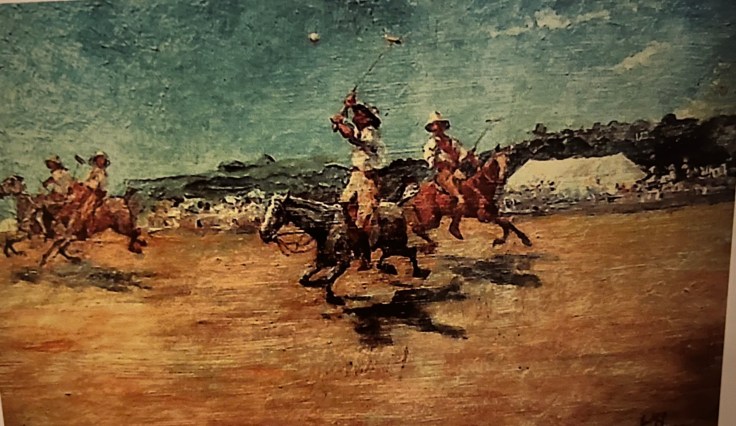
The player’s atypical stance must have immediately intrigued my dad. With only four basic shots in polo, this depiction seemed to me, well, unrefined and ignorant.
Throughout my life, I’d felt ambivalent about my dad’s collections. The sheer number of books — rife with that musty scent unique to antiquated, leather-bound texts — overwhelmed me. But whenever I’d ask, ¿Daddy, donde esta….? he’d direct me straight to my desired volume.
About his art acquisitions, I thought, how many polo paintings does one man need? All were essentially the same. Over the years, most visitors to his homes remarked some iteration of This place is like a museum. Despite my dad’s gregarious nature, he, and his environs, could be intimidating.
During the pandemic, when my dad relocated to Colorado, we shipped 176 boxes of books and about 200 works of art, from bronze sculptures to watercolors, oils to etchings. My interior-designer friend Erika helped me unpack and hang them. What seemed a tedious task was for her like Christmas morning.
“Look at this amazing sky! The use of light!”
“Those storm clouds!”
“Oh my goodness, Gisèle, this one has incredible movement!”
“See how this artist blurred the dirt and forelegs where the hooves hit the ground!”
And finally, as stacks of gilded frames accumulated around us, “Let’s group them in rooms by theme.” By theme? I remained skeptical, but I was starting to get the picture.
Erika’s aesthetically-trained eyes helped me see my dad’s collection through a fresh, appreciative lens. I began closely examining each work, curious to perceive what she, and by extension my dad, saw. What I’d dismissed I now found mesmerizing.
Which led me down a path close to my researcher-heart: a surprise gift to update my dad’s old cut-and-paste notebook of artist biographies and provenance details. Initially I thought I’d complete the project by Christmas, 2020. But I fell down innumerable rabbit-holes, captivated by tracking down missing minutiae: the identity of the socialite who commissioned portraits of a pony trio in their stalls; biographical details of the sculptress of a bronze, Nearside Forehand, which smoothly exemplified a textbook polo shot; the life story of a half-native Hawaiian, Harvard-educated artist — formerly an agent for the CIA’s precursor during WW2 — who also created dioramas for renowned museums. My deadline became early May, my dad’s 86th birthday.
The more I delved, the more I imagined my dad’s reactions as he accrued pieces: his thrill when he’d found two original Alejandro Moy sketches of 10-goalers in a Palm Beach thrift shop; his animated conversation with Enrique Castro, a contemporary Argentine painter, who offered to honor my dad’s rural hometown team by depicting their tangerine-colored uniforms; hearing from Roberto Ceriani, his childhood best friend, of an upcoming auction of his favorite artist, Thomas LaFontaine.
I learned that, since horses were an available resource to deployed Victorian armies, polo’s diaspora was fundamentally British, even in Argentina. As cavalry squadrons colonized continents, polo emerged as a form of exercise and entertainment for officers. Where the British went, polo followed.
Rudyard Kipling (1865-1936) fraternized with British officers in India, eventually becoming a polo enthusiast. First published in the Pall Mall Gazette in 1895, The Maltese Cat features an anthropomorphized horse as the titular narratorwho simply loves polo. In Kipling’s inimitable style, The Cat converses with his fellow equines, while providing a play-by-play of an on-going match. A level-headed captain, teacher, strategist and cheer-leader to his teammates and even his rider, The Cat guides his regimental team to victory. It’s a quintessential underdog story of belief and self-worth when facing superior opponents, the sides serving as metaphors for socio-economic class differences.
As journalist, Hale covered the Russo-Turkish and Afghanistan wars. My dad hypothesized that Hale’s scene might have depicted the shot described in The Maltese Cat, which had been published four years prior. I might venture a step further, finding proof the two were acquainted: Hale had illustrated a Kipling book in 1889.
Kipling’s title utilizes word-play: Maltese cats have solid grey coloration, and his horse-protagonist originated from Malta. Skikast, the pony featured in the written version of this shot, was “a little grey rat with no pedigree and no manners outside polo.” Although fewer than 10% of horses are greys, in Hale’s painting, the central figure features a grey horse, whose rider’s actions imitate Kipling’s words: “[Powell] played a stroke that sometimes comes off successfully on a quiet afternoon of long practice. He took his stick in both his hands, and standing in his stirrups, swiped at the ball in the air, Manipore fashion.” The similarities seem more than coincidence.
Regardless of whether Hale intentionally referenced The Maltese Cat, his painting is the only known depiction of the loose-reined, two-handed, overhead shot.
Despite his receipt of the 1907 Nobel Prize for Literature, many of Kipling’s works, including details in The Maltese Cat, haven’t aged well. I cringe at his use of the word “natives.” Yet, like Hale’s contemporaneous painting, the story snapshots a time and place where cultural norms ruled, literally and figuratively.
Qualms aside, I couldn’t wait to present my dad with his gift.
But I was at least one rabbit-hole too late. My dad, my brilliant dad, could no longer read.
Alzheimer’s took his mind, piece-by-piece, along with its associated abilities: signing his name, speaking English (his second language), recognizing his daughter. I’d yearned for his acknowledgement of my efforts in understanding his collection. And maybe, subconsciously, him. When he received my gift with indifference, I was openly devastated. My dad, the version I knew, would have been delighted. I grieved the loss of my father, even as he sat right in front of me, sipping spoonfuls of French onion soup.
A few afternoons later, my equilibrium reestablished, one of his caregivers shared their daily vignette. “Horace,” Betsy said, “loves his art catalogue. He picked it up today and looked at the cover,” which featured his most-cherished LaFontaine oil, “then he looked up at the painting,” prominently displayed on his living room wall. “Back down at the cover, back up at the painting.” She mimed his movements. “And then he grinned at me.”
“That’s right,” Betsy confirmed my dad’s nascent understanding, “That’s the same painting. It’s yours.”
None of these paintings are ours anymore. After my dad’s passing, the entire group of equestrian books, art and memorabilia sold for their combined value to a private collector. Astoundingly, Hale’s painting was individually appraised at only $800. Who am I to question market value? The unassuming can be immeasurable.
Gisèle Laffaye Pansze is currently a student in Goucher College’s MFA in Non Fiction program. She is writing a memoir about finding truth within disparate narrative of self: the ones we are raised to believe and the ones we come to understand. She resides in Durango, Colorado.
 After the Art