by Ellen Santasiero
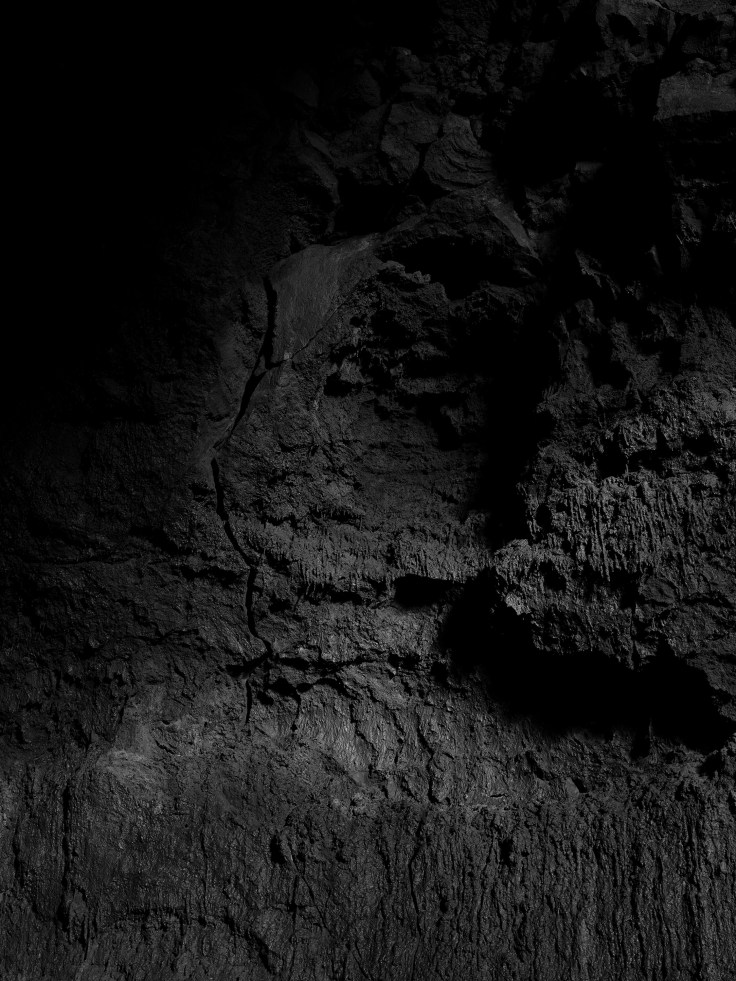
A cave wall lit with dim, natural light.
Such is the subject of Lava Tube Wall with Fracture, (2017) a large format pigment print by Ron Jude exhibited in upstate New York at the Hyde Museum in 2023. When I saw the photograph, I recognized that wall, or rather, it looked like cave walls I’d seen before. It looked so familiar I could practically taste silicate, maybe—probably—because I had just moved east after spending three decades in the arid west, a place known for this kind of geologic feature.
At the panel discussion during the opening of Jude’s 12h exhibit, I asked the photographer where Lava Tube Wall with Fracture was taken, and he confirmed that it and other cave images in the exhibit were taken in central Oregon, on top of an 80,000-year-old volcanic system, upon which my former home had been built. It turned out I had been in the lava tube he’d photographed, had passed by, with a hissing lantern, that very wall with the fracture, but that was a long time ago, before my decision to move east and the divorce that preceded it.
The photograph shows dripping lava hardened in place, small black recesses, striations, and the kind of scalloped shapes a spatula makes when you spread frosting on a cake. The fracture referenced in the title is slight; it draws no more attention than any of the wall’s other features, and so we spend time hunting for a focal point. This is made easier by the fact that there is only foreground in the photograph, which forces us to stay within the image, an experience by turns interesting and suffocating.
Jude’s stated intention in that exhibit was to de-center the human. As a text panel reads, Jude has photographed “phenomena independent of the human enterprise.” Indeed, while considering the stark images of rock we feel practically nonexistent in the larger story of geologic processes. Of his images, most of which have nary a plant in them let alone a human, he writes, “By making photographs that propose something bigger than the human experience, I hope to provide some perspective and a sense of scale. By stepping back to look at the larger system in flux of which we are only a small part, I want to find my own pulse, as it were, and assert an appropriately scaled sense of being within a hierarchy of this system.” There is a not-so-veiled suggestion there for the taking.
Someone asked the geologist on the panel what came to his mind when he looked at the exhibit, and the geologist, an affable fellow with thin blonde hair to his shoulders, said, “time.” I didn’t think of that even though at home I was re-reading The Magic Mountain by Thomas Mann, that famous 1924 novel about many things, but chief among them, time. Of course, I thought, listening to the geologist, Jude’s photographs are, in one sense, about time. I guess in a way I actually had been thinking about time, too, since the photograph had sent me back into my personal past.
***
Thomas Mann gives us a lot of information about his protagonist Hans Castorp’s personal past in The Magic Mountain, one enriched by stories of ancestors that make young Hans feel “a reverently preserved connection of his own life in the present to things now sunk deep beneath the earth.” But when Hans goes to the sanatorium in the Alps, the Berghof, he experiences time as anything but linear. The dead don’t necessarily stay in the past.
There is a scene about halfway through The Magic Mountain where Hans watches a silent travelogue film. Of the actors he saw on screen, the narrator says that they “had long since been scattered to the winds.” And that the audience “had watched only phantoms, whose deeds had been reduced to a million photographs brought into focus for the briefest of moments so that, as often as one liked, they could then be given back to the element of time.” Given back to the element of time. To live again, in a way.
This is just one of the many passages in the novel where Mann’s narrator, or characters, discuss time, its seeming elasticity or its indefinable nature. But unlike Ron Jude, Mann does not respond to time’s weightiness by having his protagonist “assert an appropriately scaled sense of being.” If anything, he has Hans tuck in with even more enthusiasm to the Berghof’s sensual delights, including “second breakfast” and all it represents on both the physical and intellectual levels.
I don’t mean to just point out that Jude and Mann are up to different things in their work—that Jude’s work is art with an environmental message, and Mann’s is more ambiguous—but that in their different approaches, they both perhaps say more about themselves and their respective eras and geographies than they do about time or how to live life within or out of it. Perhaps most artists do.
***
Standing in the gallery, looking at Lava Tube Wall with Fracture, I was pulled back to a time when I used to explore caves with my husband near our home. It hadn’t been that long since I’d left Oregon, but my new geography was so different from it that I was startled by an image so familiar, the cave wall, and by extension, a memory of something dead given back to the element of time. It was then I realized I was not Jude’s ideal viewer, at least not on that day. The photographer wanted me to forget my human narrative, but all I could think about was my past, and how easily it could supplant the present, much like the phantoms in the film do in Mann’s novel. I thought I had left so many things behind, but I hadn’t. Perhaps I never will.
Ellen Santasiero’s work has appeared in The Sun, Bull Men’s Fiction, Dorothy Parker’s Ashes, High Desert Journal, and in Oregon Humanities. She teaches at The Forge, a ten-month online creative writing program she co-founded in 2021. She lives on the southern edge of Adirondack Park in upstate New York.
 After the Art