by Natascha Holenstein
Picture me not as I am now, but as a young girl, sucking the stems of sour grass and weaving the bitten stems in my hair. Barefoot on scorched cement, watching the sun dip its head low amongst the cry of crickets. I pick California poppies from the neighbor’s garden and press the petals against my nose, inhaling sickening sweet breaths. My body is the channel that braids me into the fabric of this earth. Remember this for me, because I will soon forget.
I grew, albeit slowly, and my little girl body became something more complicated. All girls know this: as you grow, your body stops becoming your body and instead becomes something to look at. Something to paint and doll up and squeeze with grubby fingers. Something to remark upon, to shrink, to worship.
After trying and failing to adjust to being a woman with a body, I spent a good chunk of my life bouncing between the doctor’s office and the mental health clinic. My therapist adamantly recommended that I read Girlhood by Melissa Febos, a collection of essays that examine her own transition from girlhood to womanhood and the societal forces that shaped her as she grew. I put down my fantasy escapist stories and found myself looking into a distorted mirror. One essay in particular, titled “Wild America,” details Melissa’s childhood and the contrast between how she experienced living in her body as a child and as an adult:
Before I learned about beauty, I delighted in my body. I was a passionate child with callused feet and lots of words. I talked fast and moved faster — through the woods around our Cape Cod home, up trees, and into the ocean’s crashing surf. Finely tuned to the swells of my own and others’ hearts, I sensed a deep well at my center, a kind of umbilical cord that linked me to a roiling infinity of knowledge and pathos that underlay the trivia of our daily lives. Its channel was not always open, and what opened it was not always predictable: often songs and poems, a shaft of late-afternoon light, an unexpected pool of memory, the coo of doves at dusk whose knell ached my own throat and seemed the cry of loneliness itself.
This passage thrums through me with a tremulous sadness. I have felt what Febos is describing here, that corporeal connection to the sublime that is so easily accessible as a child. How have I gone so wrong that my body, this minute miracle that connects me with all things vital, has become the object of my affliction?
“Before I learned about beauty…”
During this period in my life, I found another book veiled in a thin layer of dust on the art shelf of my favorite used bookstore. It was a book of Pre-Raphaelite art that enraptured me with its dramatic subjects and complex compositions. I immersed myself in the aesthetics of the era. Scenes of nature shaped in exquisite detail. Vibrant colors and girls with auburn locks and rose-tinted lips. The romance of it all enthralled me.
Tucked in the pages of this book, I discovered The Mirror of Venus painted by Edward Burne-Jones. Carefully depicted in oil strokes, ten women huddle together around the edges of a small pond. Seven women are hunched over, draped in Greek tunics of muted crimson and cerulean, gazing at their own reflections with fervor. One woman pushes another to the side to catch a glimpse of her own face. Their expressions are subtly expectant; in their likenesses, they are searching for something more than what they see. Two women kneel at the edge with the others, but their gazes are cast upwards at Venus, entranced. Venus herself is not crouched down, but upright and wrapped tightly in blue fabric, dusty blonde hair tied behind her head. She mindlessly fondles a stem of myrtle with two fingers, and her gaze is directed towards nothing in particular. And while the pond reflects a few faces in its clear surface, Venus’ reflection is obscured by a splattering of lily pads. Surrounding the women are small bunches of blossoms, desolate grassy plains,and mountain peaks stretching towards the pale, clear sky. The natural scene is serene in its simplicity, vast in its landscape.
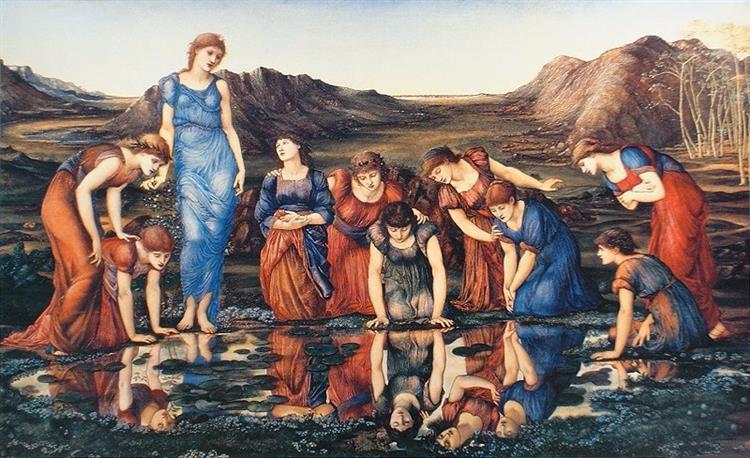
What strikes me about this painting is how women are so utterly absorbed in their own reflections that they are completely disconnected from the landscape around them. They are not aware of the patches of blue blossoms, nor the endless sprawl of grassy valleys. They are not interested in the winding path on the right side of the frame that weaves through spindly trees, perhaps leading to a dappled meadow or a hidden outlook. Their bodies are not for experiencing the world around them, but for admiration and scrutiny. But what of those two looking to Venus? Their gazes are cast in reverent longing, as a mere mortal would look to the goddess of beauty. Unlike the others, Venus does not seek out her obscured reflection, and we as viewers are not given the honor of seeing it. She is not lost in the mirror of her beauty, but her vacant stare is tired and jaded. Perhaps she knows what the others don’t.
That our fixation on our own beauty, however entrancing, is ultimately futile. That by valuing our bodies for their appearances, we deny ourselves connection with the world around us. Who would know the consequences of beauty better than the goddess of the thing itself?
I believe we have all been those women kneeling at the edge of the water. We turn our heads while walking byshops to get a glimpse of our figures in the tall windows. Who hasn’t stared at their reflection in the window of a parked car only to cringe away in embarrassment upon realizing that somebody was inside the whole time? These mirrors are not just momentary distractions, but they permeate our everyday. Because there have been countless times where I haven’t sat down in the grass for the fear of getting my skirt dirty. There have been meaningful moments of conversation when my thoughts strayed from the talking and to the mascara that likely smudged under my eyes, to the fit of my too-tight top around my ribcage.
How much of the world have we missed out on to pursue our own beauty? The childlike connection to the universe that Febos describes becomes dulled as the vessel for this connection is not left open, but is instead crammed full of junk. It overflows with weight loss pills, hair straighteners, anti-aging creams, and Botox. We humans are clearly not beings of moderation; it is not enough for us to decorate ourselves with fake gold and kohl liner and call it a day. Instead, we throw ourselves headfirst into an endless race for physical perfection. This obsession circumvents our focus and does not leave space to use our eyes to gaze at that “shaft of late-afternoon light” or indulge in the “coo of doves.” We become the women at the edge of the pond, entranced by our own looks, and unaware of the vastness of the world around us. Our bodies have become not a miraculous marriage of elements that binds us to the universe at large, but an object to perceive and enhance.
So do this for me. Put on your most boring clothing. Leave your face bare and hair untouched. Find the closest patch of nature and dig your fingers into the dirt. Remind yourself what it feels like to touch the earth. Stare at a singular cloud up above and let a passing bird catch your eye as its powerful wings cast a sky-bound silhouette. Chew on a stem of sour grass and pucker your lips at the taste. Stay there as long as you can bear and remind yourself that you were formed by the elements of the earth. Next time you look in the mirror and smear rouge on your cheeks or slip into a dress, remember that the reflection in the mirror is trivial. What is most important, and what always will be, is that your body is your channel to all that is real.
Natascha Holenstein is a writer from the California Bay Area who studied English literature and linguistics. She is currently the nonfiction editor for the literary journal Rawhead. In her work, she aims to always dig deeper and unearth both the beautiful and grotesque. She is also a contemporary, ballet, and tap dancer.
 After the Art