by Tracy Ross
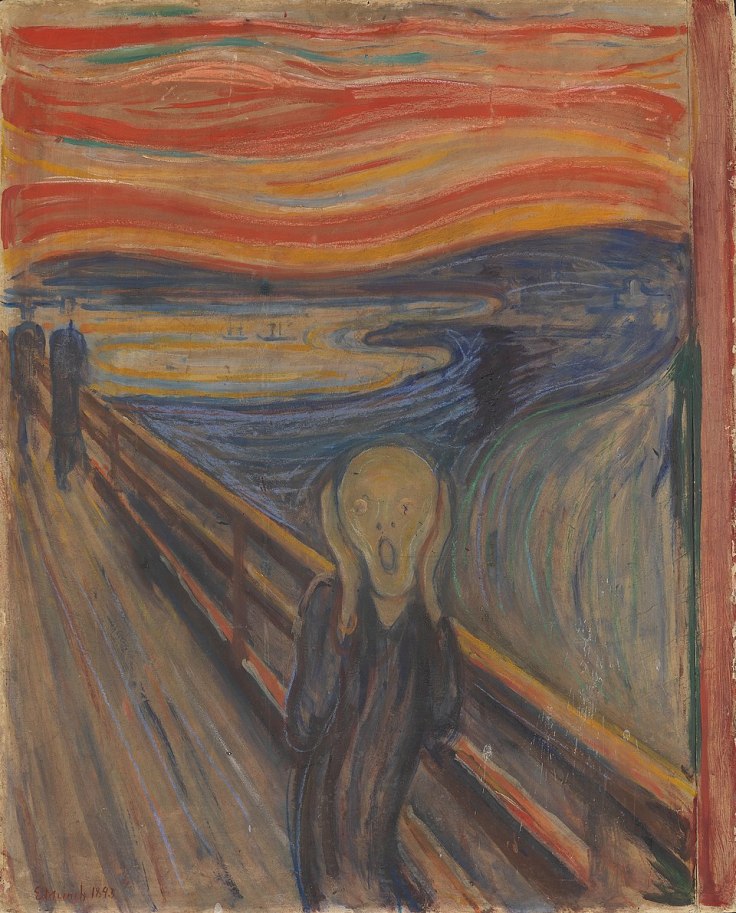
It was originally observed that Edvard Munch, the Norwegian painter, when he created his masterwork, The Scream, in 1893, 132 years ago, painted the picture by candlelight. We know this, because when the artist finished the work, he blew a candle flame out, hence extinguishing the light, and blowing a corona splatter of hot wax on the painting itself, leaving the moment preserved forever in time on the canvas along with the drying oil. It is said that those who wish to forge the famous work, must duplicate this very same peculiarity of the moment with candle light and hot wax to achieve the forgery correctly. It is also said that Munch was attempting to portray the emotion of a panic attack in physical form, while he was walking in nature one evening when viewing the sunset and the sky turned blood red. The story is that there had been a volcanic eruption, which caused the red hue of the clouds. He also happened to be walking nearby the sanitarium where his sister was staying at the time due to mental distress and emotional turmoil.
I close my eyes and imagine a tired Munch executing the last brush stroke on canvas, and as he exhales his breath outward, the room itself goes dark. The flame in front of the painting is no more. I imagine him finally going to bed, placing his head down on the pillow, and sleeping heavy, dark dreams until morning, only to wake up to the reality of his painting The Scream waiting in brilliant daylight to remind him of the previous evening’s vision. Garish and haunting, is the artist’s dream.
There is suffering in every man and woman. When the bird eats the worm, there is suffering. These things sadden me. But what is worse, is the meaning behind the consequence that alludes me even more, the chaotic chains of happenstance that I attribute meaning to and take on to burden myself with throughout my life. Even gravity wishes me to put down a mountain and not carry it around. The rain will wash away the dirt and make a mountain smaller still. Yet, I persist in carrying the dirt. I persist in carrying stones around as if the Earth cared one iota, and I could make its turning on the axis lighter day by day. I fail to realize that I cannot be privy to a full-proof weather report to shield me from the storm. I drag my feet, cursing mortality and my powerlessness against entropy with every step.
Shakespeare’s Macbeth speaks for us all:
Tomorrow, and tomorrow, and tomorrow,
Creeps in this petty pace from day to day,
To the last syllable of recorded time;
And all our yesterdays have lighted fools
The way to dusty death. Out, out, brief candle!
Life’s but a walking shadow, a poor player,
That struts and frets his hour upon the stage,
And then is heard no more. It is a tale
Told by an idiot, full of sound and fury,
Signifying nothing.
Yet, it is the artist’s intent that is the puzzle. Out, out brief candle.
Did Munch know? I wonder. A profound question indeed…
“Know what?” you ask.
Did he intentionally merge the metaphor with reality, the mortality of man, with the actual candle and its extinguishing. Did he know that the corona that would be left as a crown of tiny speckled waxy thorns on the canvas itself, would mark the moment in time in that vain, clarifying that meaning for us forever? I think he did.
But through art, he left the legacy, through the painting he preserved his moment in time for eternity. It is a masterwork, The Scream. It says something in silence, with deafening, piercing reality that we all hear and feel. Edvard Munch succumbed to the worms, like we all must do. Yet, by the Grace of God, he got it right. He understood that as we create, we etch out a piece of time, a sliver that is as transparent as glass and indestructible as a diamond. In our attempt to create, we seek the face of God, we seek communion not only with the stars, but with humanity. We grasp out from the present into the future for a timeless unity with those that are living, and will live tomorrow. Munch’s legacy is the connection. It is the touch of his hand through the pages of days and years, to lift the veil from our eyes to see in the present what is universal for all of us. Suffering in the red light of day. Lives of quite desperation shouting through the void with voiceless emotion that is in the blood and bones of every mortal being. Suffering is under the skin, it is running silently through the veins, it is in the very witnessing of the falling sand in the hourglass as a glint of sun creeps across the floor of our rooms.
And what a canon of art it is — the theater, the statues, the beautiful oil on canvas, the movies, the libraries of books, the typed words on paper, all the Mona Lisas and Rembrandts — all to capture a bit of our loneliness to share with one another. The beautiful loneliness. Each night I close my eyes to dream, I see humanity’s breath extinguishing the flame. I see the souls of the world sleeping too — praying for no more tragedy, no more suffering. Yet, I thank those who see the darkness to show me the light that once was, and is now as I rest in my dream, above me in the moon and the sun, carrying me through the beauty of days and nights. Thank you, Edvard for the pain. Thank you also for the light in your vision, to help me see the sun rise after the darkness.
Tracy Ross is a poet and writer. She has published four books of poetry, most recently When Lightning Strikes—Nikola’s Dove about the life, genius, and neurodivergence of Nikola Tesla. She is also the author of Binary Logic (short stories), Certainty of One—A Tale of Education Automation (dystopia memoir), and is a recipient of both a Minnesota State Arts Board Creative Individual’s Grant and a Prairie Lakes Regional Arts Council Grant. She teaches at Augsburg University and holds both a MFA in Creative Writing from Augsburg University and a MS in Education from Bemidji State MN. You may learn more about her and her work at https://www.rosspoet.org/.
 After the Art