by Kevin Parks
On the final day of Michael Richards’ retrospective “Are You Down?” I was, for a time, the only visitor at The Bronx Museum. In most cases, this would be a dream — an empty movie theater or apartment are elusive, blissful sanctuaries — but an hour alone there conjured a pesky, unavoidable gloom. The museum was so full of Richards’ youthful, near reckless artistic zeal, yet knowing that he died on September 11th ensured a melancholic cloud would follow me around and out of the space. I wanted to balance quiet reflection with bursts of gratitude to the curators (Alex Fialho and Melissa Levin[1]), offset dreary meditation with animated expressions of appreciation that the exhibition existed at all, providing a venue for me to take a hard look at my own history. Keeping to myself then, I’m just now attempting to articulate that heightened emotional state, rooted no doubt in the fact that Richards’ North Tower studio was ten floors below the offices of Cantor Fitzgerald, where my dad was also working that same day.
Walking around the museum felt like a speed dating session with the fourteen-year-old high school freshman version of me, who had hustled home from the bus stop and tried hopelessly to reach my dad on the phone. Now, at 38 years old, I’m the same age Richards was when he died, and only nine years younger than my dad then. In an alternate universe, I envisioned my dad getting a kick out of Richards’ brand of humor (especially the playful pencil sketches and the sculpture that resembled Slim Pickens on top of the atom bomb in Dr. Strangelove), his name (Kramer! He loved Seinfeld.) and bold, cinematic flair. Richards’ art tells just as well as it shows, substituting for the written or spoken word to explain how the world kicks the shit out of people, and bruises remain for generations. That hard-luck worldview should have resonated with my dad who, at the time of his death, was beginning to recover from a dark period. In short succession, my dad’s dad died, and he’d been fired, hired and fired again, and then he’d separated from my mom. His reaction to these life crises ranged from self-medicating (alcohol) to criminal (stealing a signed baseball) to hopeful (knocking on a neighbor’s front door because it was a nice house! He might be hiring!) but landing the job at Cantor in the summer of 2001 promised to catalyze a major life rebound.
Applying my limited knowledge about Richards, a clear contrast surfaces between his career and my dad’s life, two men who had their futures taken away at varying stages of achievement. Richards, by age 38, had already won several competitive awards, participating in artist residencies at The Studio Museum in Harlem and The Bronx Museum, and in 2000 had a solo exhibition in North Miami. My dad had for years bounced from job to job. His living situation was precarious, too, at first staying in a friend’s apartment near my suburban childhood home but ultimately moving in with his mom closer to the city. That this coincided with the death of his own father, an alcoholic who for a lifetime had trouble finding work and rarely saw his children or their children, had to amplify my dad’s anxiety about the present and fear for what was to come.
Traditional coping mechanisms be damned, my dad fought back on his own bizarre terms. One morning, my mom woke up to find his station wagon — a clunky black Buick with wood siding — in the driveway, not her cream-colored Mercedes. For something that wasn’t discussed much then, it’s easy to interpret this now as a cry for help, a plea for us to understand that this was his car, because he was the provider, no matter where he lived. But that facile explanation diminishes the scope of his struggle, projecting a convenient me-versus-them dynamic in which the wrong victim is matched with undeserving villains.
Stealing the car was almost a provocation for us to talk about his distress, probably the most subversive thing that could’ve happened, but didn’t. Of course, my dad isn’t here to explain himself, whereas Michael Richards’ credo is still on display via art that expresses frustration and bewilderment with an ellipsis, not a period. His ability to cue up the fattest targets — the country, its racist past and that long tail of suffering — breathes air and sparks an eternal flame. The final products are fully formed, loaded with anger, not to mention symbols of otherness: Black bodies, hair, even genitalia. Richards’ agitation reverberates, demanding a second look rather than spiking and landing with a thud.
To consider any of Richards’ sculptures or sketches frozen in time, or evocative of a particular moment and only then, would be to liken his singular, troublemaking exclamations to a polemic, wherein an agreeable crowd gathers in head-nods and cloying appreciation or respectful remembrance. And yet, Richards’ work isn’t solution-based art with ready-made lessons and takeaways. His penchant for postmodernist provocation and keen social focus anticipated, or at least could serve as a necessary companion piece to go-for-broke race and class kaleidoscopes from Jordan Peele or Zadie Smith.
What Richards wants us to see is us (no Peele pun intended), to stare into the mirror and hold that gaze. It’s even suggested in the exhibition’s canny title, implicating you, asking if you’re ready (down), while also maybe gauging your temperament (down). So to laugh at Richards’ satirical sketches (my favorite depicts chicken wings in the shape of Icarus’ wings captioned: “Icarus Wings n’ Things: We Deliver”) or clutch pearls at the sight of a dismembered lower body, with an exposed penis and pubic hair — a harrowing reminder of the actual experiment called “Tuskegee Study of Untreated Syphilis in the Negro Male” — is to accept the stark truth that we are all co-conspirators, deserving a share of blame in the dismal national track record that Richards was so deft at exposing. The mind and body behind this art had a skill for expressing pain and empathy, in addition to a cockeyed cynicism at how often the past — punctuated with extended periods of mass cruelty and societal destruction — repeats itself. Planes flying into the Twin Towers, those iconic structures of American exceptionalism might have been an event concocted or imagined in Richards’ art. Instead, that’s what killed him, elevating the physical objects he left to the world to the status of eerie, harrowing relics.
In Richards’ video exhibit Winged, he pierces through his own arm with long, thick needles, a daring bit of artistic realism, if not actual body horror. And it’s neither a memoir nor a poem, so much as a monument to anguish, aligning with the physical torment of his favorite subject, the Tuskegee Airmen, horrifying real-life examples of victims reframed — for the benefit of the system which abused them — as martyr-heroes, displayed in abundance around the room. The most multi- of Richards’ multimedia work, Winged reckons with flight and death, the title a verb, suggesting a slang for a serious injury. Given Richards’ try-anything-once artistic principle, Winged could represent the dangerous temptation to “see what it felt like,” a throwaway comment on why people might harm themselves (nevermind fear, illness, relief, etc.). Offering that explanation lets us off the hook, allowing the blame to go elsewhere, that familiar thread throughout both Richards’ career and my dad’s late-life showmanship.
That I had such a hard time stomaching Winged called attention to what I must avoid thinking about, when I don’t think about my dad. Richards’ fearless physicality invited pain (Smith, in White Teeth: “Don’t ever underestimate people … the pleasure they receive from viewing pain that is not their own”), to bring him closer to his subjects, and looking around the room, it was hard to distinguish the artist from his muses. The last time I saw my father, he was, of course, a still figure, lying supine in a coffin. Every so often, the thought of how he died will seep into my mind, but I can’t chase it away fast enough. I haven’t sought an answer to that morbid curiosity, which pops up without warning or effort, and wonder now only because I think about Richards’ body, and how he deployed it for his art’s sake. Would that make him more likely to jump from the collapsing building, or to stay put in his studio (his Dr. Strangelove-esque piece was believed to be with him; only a photograph of it exists), protecting the work that molded him?
The duel between survival and escape calls to mind Richards’ commentary on flight (it offered both “freedom and surrender”), and why it’s such an expansive theme. This preoccupation also makes it impossible to separate the artist from how he died. The centerpiece of Richards’ retrospective, Tar Baby vs. Saint Sebastian is a layered, intricate model of a Tuskegee Airman, the title invoking both the religious martyr Saint Sebastian and the Southern folktale “Tar Baby,” the lead character’s name in that story which has, over the years, devolved into a racial slur (and a Toni Morrison novel). Lodged into this golden-cased pilot – Richards’ own body was the casing here, as with others — are dozens of toy-sized fighter planes, nosediving straight into his body, from shoulders to pelvis. The look on this airman’s face isn’t suffering, however, it’s one of disquieting calm, the eyes closed but not forced, lips pursed gently. And his feet point straight ahead, palms up, fingers curled slightly as if receiving a sacrament. It’s a wondrous, contemplative piece, which now doubles as a eulogy for Richards, and, to me, provides a nightmarish yet angelic model for how Richards might have met death.
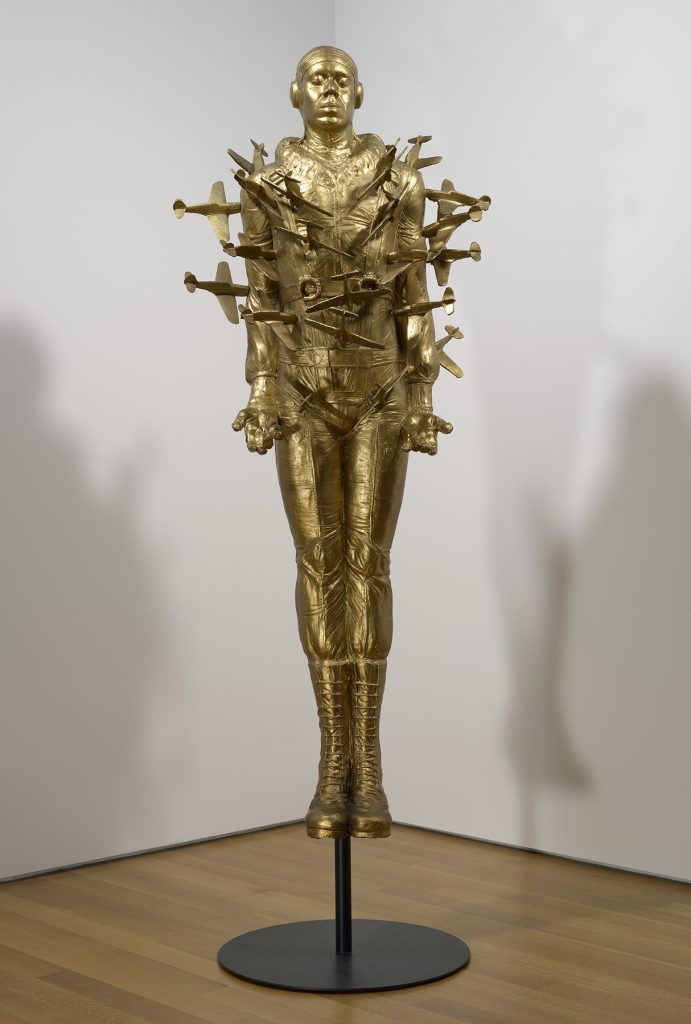
Had that sculpture been taken off its post, and laid on its back, it would fit comfortably in a coffin, the daggering airplanes a symbol of the objects which laid to rest thousands of 9/11 victims. I can never know what my dad’s face looked like just before he died, if he tried to jump or stay put, and what his final thoughts were when the planes scorched the bodies of the buildings, and brought them down in an apocalyptic blaze. But I don’t think any of that information would bring me closer to my dad, or understand what mattered to him in life, the struggles heaped on him and the self-inflicted pain offsetting the progress he leapt for in his final months. Securing a new job was a step forward, his casual, often bitter attitude towards his family a disproportionate number of steps back. The catastrophic event of his death isn’t the saddest thing, really, it’s that it all ended on such a low note, unable to surge back and take control of his life in the new millennium.
And that’s the major tragedy of an early, sudden death: the total annihilation of a future, no matter if the deceased is a gifted artist in his prime or my dad, a flawed father in need of forgiveness, who finally notched that one big win that could’ve reversed his downward spiral. Lucky for me, I was able to discover Richards’ art (stored in his cousin Dawn Dale’s garage for decades) which throbs and shouts, a voice so emphatic that the work will only grow with age. This introduction gave me an access point to thinking about my dad, entering 9/11 through the chamber of a third party who, at my age, was killed in an historic, generation-defining event while he was working alone in a studio. So the purpose of this externalized meditation isn’t to appraise Richards’ art or my dad’s death, but to capture a moment in my brain, to create an emotional record of an overwhelming and confusing experience aligning my dad with an artist whose boundless potential seized on that day.
There’s some comfort to dissecting death at a youthful remove, but it’s a blunt, boring reminder that I won’t last forever. That notion motivates me to write, if only to preserve this mindset, lock it in time, and tell myself I’ll be around to think or talk about it in a decade, and the next and the next and so on. To quote Smith, once more: “I just want to think out loud about the things that matter most to me.” It’s unthinkable to me that I could die of any cause before an appropriate expiration date, before I’m able to see my five year old daughter grow up, take the adult version of her to a library or museum, go our separate ways then get together afterwards for grimy bar food. At least allow me to make it to retirement so I can pass the hours on a couch with my partner and our dog, watching Turner Classic Movies or reading with the NBA on in the background, TV muted. So, when I think about my dad, and compare who he was with Michael Richards, what I’m really doing is taking stock of where I’m at, not so much fearing death as willing it away from me, suspending the rational belief that it may come at an inconvenient time.
Mourning my dad after 9/11 was such a public act, done at times in service for others. Erase the look of despair, reduce unease in others and arm them with an uplifting portrait of resilience: the resolute widow and her fatherless children thriving in AP classes and varsity sports. Not killing oneself was, for a time, the low bar to hurdle over to inspire others. Even solo trips to my dad’s grave took on a performative streak, surrounded by the silence of hundreds of dead people, a gonzo religious ceremony with my own silent sermon. So the hour I spent touring Michael Richards’ art and life allowed me to go at my own pace, to slow down, speed up, do another round and then leave. Writing about it all is rewarding but exhausting, and I can’t say what I’ll want to unpack about my dad years from now. But I’m grateful for what Michael Richards unlocked in me, bringing my dad into clear view, permitting me to hold tight then let go, and commit my thoughts into a cohesive structure. To revisit history, leave it here in the present, and then argue with it again in the future, when I’m down.
[1] Fialho and Levin co-edited “Michael Richards: Are You Down?” Published in November 2025, this monograph is an essential primer and dutiful summary of Richards’ life and career.
Kevin Parks is a freelance writer and film critic whose work has been published on The Movie Buff and Drunk Monkeys. He’s also working on a collection of short fiction. He lives in New York with his partner, their daughter and dog.
 After the Art