by Ginger Hanchey
“The figure of a labourer — some furrows in a ploughed field — a bit of sand, sea and sky — are serious subjects, so difficult, but at the same time so beautiful, that it is indeed worthwhile to devote one’s life to the task of expressing the poetry within them.”
— Vincent Van Gogh
The relationship between poetry and visual art is a fascinating one, and worth considering within the practical context of the creative writing classroom. I was happy to bring these together in a class I taught this summer called “Van Gogh and the Poetic Image,” a two-and-a-half-week study abroad class located in the south of France. Our travels took us from central Texas to Arles and Saint Rémy, sites where Van Gogh was hospitalized for much of the last two years of his life and where he created many of his masterpieces.
The essential idea of the class was to see what Van Gogh saw, to see like an artist. What did he see every day? How did he decide what to paint? How did he look at a worn pair of shoes and see — then paint — life in them? A poet’s voice is made from the registers and voices of other poets they read. We absorb poetic skills and techniques when we read and study other poems. Might it also be possible to absorb a talent for identifying powerful images as we read and study great writers and artists? It would be an exercise akin to painting the masters, but instead of studying and imitating brushstrokes, we were — albeit very loosely and unscientifically — studying an artist’s appreciation for the world while thinking about our own mental processes for making poems.
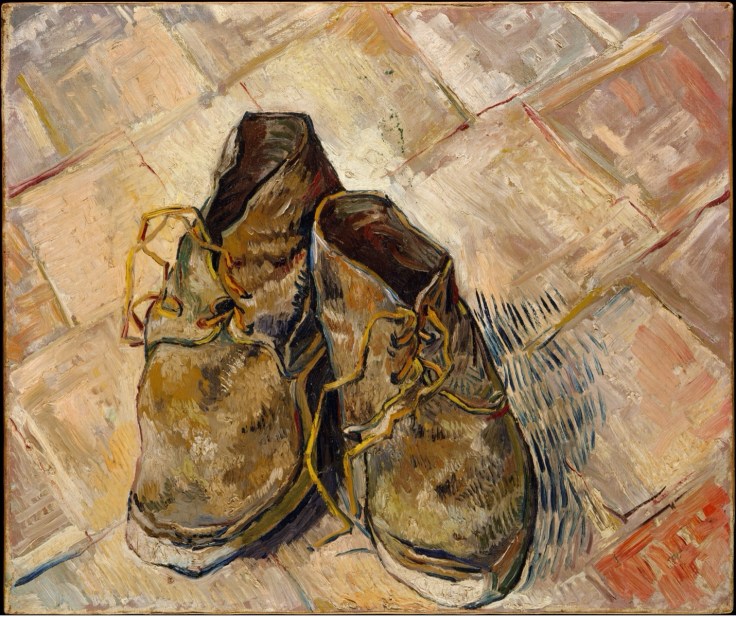
In our search for poetic images on this study abroad trip, we took advice from poet Linda Gregg, described in her essay, “The Art of Finding,” in which she encourages poets to make a daily list of six things they see. Gregg’s essay is brief and easy for students to read, but offers profound ideas about images and artistic development. I almost always assign it in regular semester creative writing classes held on campus, too, and I always pair the discussion of it with an image of Van Gogh’s painting Shoes, which he made in Arles.
Gregg talks about the unique influences on each poet’s life that become what she calls resonant sources for their art. These sources do not appear as images in the poems or as subjects for a poem, but rather shape the poet in such a way that the poem is somehow born of them or carries the pits and seeds of them. Resonant sources can be landscapes or experiences or ideologies, or any other number of unclassified things. It is a difficult concept to grasp. We guess what might have been some of Van Gogh’s resonant sources as a way into the topic. Students often name the various ways he was an outsider, his love for nature, and his sympathy for poor people and animals.
After our discussion of what we think Gregg means by the term resonant sources, we consider Gregg’s definition of “kinds of seeing.” The article divides seeing into four types, with three being kinds of seeing we should move past: artistically seeing (“winter trees immediately become ‘old men with snow on their shoulders’”), overly descriptive seeing (“describing a brass lamp by the bed with painful exactness”), and not seeing at all unless something is glaringly obvious (“the grandmother in a bikini riding on a skateboard”). The kind of seeing Gregg prizes and encourages her students to develop is seeing things for what they are, without expectation or without overlaying anything on top of them (“the mirror with nothing reflected in it”).
The daily activity of trying to see this way is difficult, Gregg says, but eventually pays off: “To write just because the poet wants to write is natural, but to learn to see is a blessing. The art of finding in poetry is the art of marrying the sacred to the world, the invisible to the human.”
After discussing what we think Gregg must mean by the phrase “marrying the invisible to the human,” we turn to Van Gogh’s painting of shoes. We first talk about the shoes as an image that carries emotional weight. Students name painting techniques that bring forth emotion, and even students with little to no background in poetry or visual art before the class can feel comfortable talking about the painting. They note the blue lines painted beside the shoes, and the wavy lines Van Gogh uses to give form to the shoes, as strategies to convey life and movement, even though the shoes are resting. Very often, students also recognize that the shoes make us think about the life of their owner and the person’s lived experiences — the owner must be tired, work hard — and that the shoes also seem to be endowed with spirit and life in and of themselves thanks to the moving lines beside them. The position of the shoes, one tilted above the other with their laces hanging askew, also suggests a person having just stepped out of them. Van Gogh looks for the human, even in the non-human, as Shoes attests, and it is this kind of seeing that is inherently empathetic.
Gregg’s guidance for developing the kinds of things we see is enormously helpful. It is a seeing worthy of Van Gogh’s own philosophy of artistic attention. In a letter to his brother in the last year of his life, as he is living at the Saint Rémy asylum and when his artistic powers are at their highest, he writes:
As for me I do not know what to wish, to work here [at the Saint Rémy hospital] or elsewhere seems to me to come to very much the same thing, and being here, to stay here seems the simplest thing to do. The days are all the same, ideas I have none, except to think that a field of corn or a cypress is well worth the trouble of looking at close to. To learn to suffer without complaint, to learn to look on pain without repugnance, it is exactly in that that you run the risk of vertigo; nevertheless you catch a glimpse of a vague likelihood that on the other side of life we shall see good reason for the existence of pain, which seen from here sometimes so fills the horizon that it takes on the proportions of a hopeless deluge. About this we know very little, and it is better to gaze at a field of corn, even in the form of a picture.
Image, whether in the world at large, in a painting, or in a poem, provides consolation and meaning for the lived experience. Poets like Gregg and painters like Van Gogh offer new ways to see the world, and their writings and their example assure us that seeing like an artist is a skill that can be developed and honed, and one that will enrich our lives in profound ways.
References:
Gregg, L. (2006, October 25). The art of finding. Poets.org. https://poets.org/text/art-finding
Van Gogh, V., & Stone, I. (1995). Dear Theo: The autobiography of Vincent Van Gogh (I. Stone & J. Stone, Eds.). Plume.
Ginger Hanchey is the Director of Literature and Creative Writing at Baylor University and the Director of Core Curriculum at Baylor. She has poems published in journals like Nashville Review, Foundry, Tar River Poetry, and Rust + Moth. Her chapbook, Letters of a Long Name, was published through Finishing Line Press.
 After the Art