by Matthew T Phillips
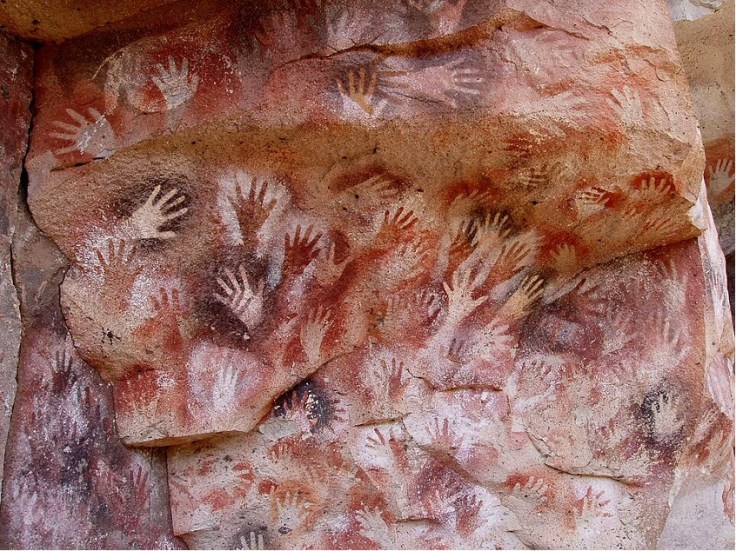
Hands splayed over a cave wall. Their fingers traced by clay dust sprayed through a hollowed bone pipe. A people speaking through negative space. Unseen for a thousand years.
Me, at sixteen, meeting that homeless guy at the train station. Him taking my friend and me across the road to an abandoned hotel. Through the red door. Down the stone steps. To the underground city hidden beneath. To a chamber where he had hung huge portraits of his loved ones. Long gone, but resurrected as strange caricatures. The paint mixed with self-rising flour, so that their faces bulged out of the canvases. Reaching out to him. Protruding into his present. And he, like a ritual king, with his invisible vigil, watching over this sacred grove. His subterranean shrine of remembrance. Protecting the memories of those he loved most.
A paleolithic painter crouched on the cave floor, mixing his pigments as the sun goes down. Red and yellow ochres, charcoal, manganese, mixed with plant juices to bind to the walls. Maybe a little moonmilk dripping from the dolomite like soft white tears from the world beyond. Smeared on the walls with pads of lichen or brushes made from feathers and furs. The darkness now spreading. But the artist stays behind. Driven by a spark lit from within. The spirit of his ancestors, of his loved ones, of his descendants. Their memories, dreams, fears, desires, figures, symbols, fugitive traces, flooding the walls, adorning all time.
Me, as a kid, always scribbling in my school books. Filling the tired pages with my tiny little daydreams. Pencilling my way out of the school day. Trying to escape it. Trying to make something happen. On other days, my friends and I, wagging school and walking through the city’s storm drains. Crawling further and further into small black spaces. To, all of a sudden, come across the glowing walls of graffitied faces. Painted in the dark for whoever might find them. Anonymous offerings to an imaginary audience. Graffitied tunnels, artist’s bunkers, hidden kingdoms just beneath the surface. Only discovered by those willing to see.
The children of Montignac, searching through the woods, looking for their dog. Who came upon a hole in the ground and heard their pet whimpering from within. So, they did what any child would do, and climbed into the hole. But the hole was not a hole. The hole was, in fact, a passage and the passage was, in fact, a series of chambers. So, deeper and deeper they went. Until, all at once, they found them, on the ceilings, on the walls, a plethora of ancient art. Like walking through a spider’s web and piercing the thin membrane that separates our worlds, they came across the cave art. Horses, bison, stags, and bears. Symbols of hooks and crosses. A shamanic figure with the head of a bird, killed and then reborn again. All to be illuminated by paraffin lamps, once drawn under the flicker of a candle made from grease and stone. The remnants of a people, of a lifeworld, long gone.
Orpheus rushing through stygian mist, tunnelling into the underworld, to bring back his beloved. Armed only with his lyre and a song, which would move the hearts of Hades and Persephone. Of Orpheus, Ovid writes, “The bloodless spirits wept as he spoke, accompanying his words with the music … the king of the deep, and his royal bride, could not bear to refuse his prayer, and called for Eurydice.” Orpheus then took his beloved’s hand and, with her, “took the upward path, through the still silence, steep and dark, shadowy with dense fog, drawing near to the threshold of the upper world.” But afraid she was no longer there, too fearful, too longing, too soon, Orpheus turned back before they’d reached the surface. “In an instant she dropped back, and he, unhappy man, stretching out his arms to hold her and be held, clutched at nothing but the receding air.” To watch her vanish back into the mist. To watch her die a second time. But there was “no complaint to her husband (what, then, could she complain of, except that she had been loved?).” His art, his song, had unlocked the soul of the dead and allowed it, if only for a moment or so, to return to the living – to be with us again.
My dad in his shed. Cutting and gluing bits of old pipe together. Measuring the lengths. Making little pencil marks. The cutting them with a blade. Then brushing off the dust. Then popping little elbows on the ends. After each cut, he taps the plastic, trying to uncover its hidden tone. Although he is going deaf, so, God only knows what he hears. But that doesn’t seem to be the point. With his father gone, his mother now too, I think he’s trying to build something living, trying to make a dead thing speak. We’ve been doing it since the beginning of time, bringing back our loved ones through art. I can imagine Adam, when Eve someday died, overcome by grief, and hacking into the tree of knowledge. Then carving out a hollow shell. Then stretching an animal skin over the opening and then pulling it tight until it sung. The new note passing over the threshold, like an algal bloom spreading across the water. Like a body in the hull of a canoe being pushed off the shore of a yellow lake. Like a hand splayed over a cave wall. The pigments seeping into the stone. Reaching out. Contacting eternity. A transmission into the void. The morse code of a distant star, throbbing across the cold black yonder. My dad calls his invention a “tubulum,” but I call it a telephone to the dead, a way of speaking to them through music, and a way of resurrecting them through art.
But the dead can never truly remain with the living. Resurrection and contact can lead to erasure. Memories of our loved ones erupt within us, like the reopening of a cave, with the daylight flooding inward. But memories change the more we revisit them. The mood, the figures, the themes, like the atmosphere in a cave, gradually contaminated by contact. The visitor’s breath brings moisture and CO2, which alters the chemistry within the cave. This encourages the formation of mineral deposits, like salt seeping into the rock and crystallising, then expanding and contracting as the temperature changes, causing the rock and the art to crack and fade. The past and the present can never coexist. The hand of the dead and the hand of the living can never truly touch.
Matthew T Phillips is a writer and anthropologist based in Melbourne, Australia. His research interests include aesthetics, ethnomusicology, philosophy, consciousness, mythology and psychoanalysis. His writing has been published in various academic and literary journals, such as the Journal of Popular Music Studies, the Brussels Review, The Metaworker, and Pulse magazine.
 After the Art