by Dian Parker
When I was a senior in high school, I ate an entire bag of oranges while lying in the dark talking to my best friend on the telephone. I was telling her that I had failed our junior year and was faking my way through senior year so I could graduate on time and get out of school that I hated with a passion. I never told anyone I’d flunked, not even my parents, forging notes and lying to my senior teachers that they’d made a mistake on the roll call. This was my first time confessing, all the while wolfing down that bag of oranges. When we hung up, I lay on the bed in my orange state watching a troop of flying elephants on the ceiling. In the end, I did graduate with my “regular” class, sweating buckets the entire year that I’d be found out.
The orange color is flamboyant, radiating warmth and energy. There’s the ripe brilliance of autumn before all goes bone white and cold. When green chlorophyll stops flowing, the orange color is left. Ancient Egyptians used the mineral, reálgar, which contains arsenic and is highly toxic, for the color orange in their tomb paintings. They also used safflower, “a bastard saffron,” to dye the mummy wrappings, and to turn their ceremonial ointments an oily orange. The mineral, orpiment, a deep golden yellow-orange pigment, was used for illuminating manuscripts, and to poison arrows during the Roman Empire. The Chinese used orpiment for medicine, and the early alchemists used the mineral in their search for gold.
I painted the door of our garden shed bright orange. When people see it for the first time, they laugh out loud. Even a friend whose taste is decidedly monochromatic, her house inside and out grey, is delighted by the door. The color exudes joy. In winter, against heaps of white snow, the color warms me. Come spring, when I first open the door to get out the garden tools, I feel it glowing.
During the Middle Ages, saffron was smuggled to England from the Middle East in a hollow silver cane. Saffron was and still is prized as a luminous orange dye, as a spice, and as medicine. It was also used as an aphrodisiac, and to cure toothaches and the plague. Alexander the Great used saffron to make his locks look gold. Zoroastrian priests used it to make sunny ink for writing prayers to ward off evil. The Yellow Emperor of the Ming Dynasty sailed in his saffron barge along the Yellow River. An early 17th century recipe for paint made saffron into a pigment by using egg whites left standing for one and a half days. Today saffron costs $10,000 per kilogram which takes 40 hours of labor, picked and processed by hand–150,000 flowers, 450,000 stigmas, to make one kilo of saffron. Kashmir’s cultural identity has always been saffron but now, due to climate change, their thousands of acres of crocus are drying up. Saffron is now being grown and harvested in Newbury, Vermont!
To cook with saffron is expensive so here’s some tips: 1. Use saffron threads and not the powder (threads last longer). 2. Soak the threads in water to bring out the flavor. 3. Use it at the beginning of the recipe to reap the flavor, and avoid any strong spices that saffron has to compete with. I sang Donovan’s “I’m Just Mad about Saffron, and Saffron’s Mad about Me” all through high school. He probably wasn’t singing about the spice.
On a kibbutz in the Negev desert, I rode bareback on a grey stallion in the early evening when the air started to cool. Semek had a mind of his own and often took off at a fierce gallop that I had no control over. I tried pulling hard on the reins, seesawing the bit, and screaming, but in the end I had to surrender to his brute strength, press my thighs into the muscular flanks, wrap my arms around his powerful neck, and hold on. I learned how to surrender on Semek, letting him take me where he needed to go, which was usually back to the barn by way of an orchard of orange trees. There, he would calm down. Our breath slowed and we became still at last. It was the smell. Early evenings the orange blossoms’ fragrance melted us into a rapturous dream, and Semek walked with his eyes closed through rows of trees on a carpet of white flowers covering the sandy desert ground. The smell continues to haunt me, fueling the need to find its equivalent in perfume. I’ve since found that there’s nothing that comes close to recreating those dreamy evenings, which doesn’t mean that while writing this essay I haven’t ordered from Mexico a tiny bottle of Oronardo fragrance. The perfumer combined mock orange blossom, Queen of the night flower, marigold, Mexican tuberose, and yellow oleander flower and described the scent as “luminous, elegant, opulent, golden.” None of that describes the scent of orange blossoms to me but I’ll reserve judgment until the bottle arrives. What I’m after is the smell of horse sweat mingled with millions of heady orange blossoms at our feet and overhead, dropping lazily on my skin and Semek’s long, lush, smokey-grey mane.
The bitter orange came from Southeast Asia via India, arriving in Spain in the 10th century, and was then introduced to Florida and the Bahamas. The famous Seville oranges, too bitter for marmalade, are best bought during a few short weeks in January. Wild, sweet orange trees grow near streams in the woods away from humans, like all wild things. I bought a mock orange bush and planted it in our front yard. The bush gives me two weeks of swooning with plump white blossoms and the lovely smell. When I first went to Hawaii, I stepped out of the plane onto the tarmac and was hit by a wall of heat and the smell of tuberose. For a moment I felt faint and thought I spied a grey horse standing alongside the airplane.
Yellow onion skins, carrots, alder tree bark, eucalyptus, and butternut seed husks are all natural orange dyes. Buddhist robes were once dyed with turmeric, and later jack fruit. Now, due to cost, synthetic dyes are common. I collect yellow and red onion skins to use for a natural dye. Soaking cotton or silk in the hot mixture produces rich amber, soft apricot, and peach-colored fabrics, dying my hands henna like brides’ hands tattooed for their new husbands. During the Ottoman Empire, the richest orange-red was derived from the pink-orange roots of the madder bush. The result is the exuberant orange of a redhead. Synthetic dyes contain only one color, but with madder there is blue and yellow combined with the red, creating a softer, more complex color.
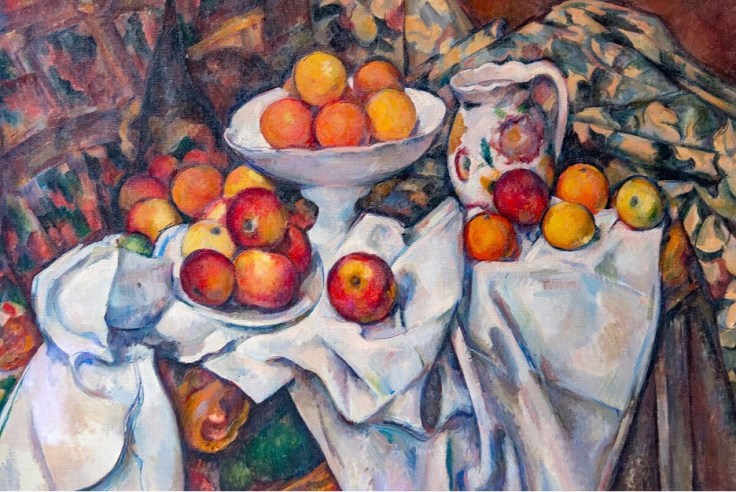
I live in Orange County, Vermont and write about artists for art publications, like Joan Mitchell who painted oranges as well as sunflowers and trees. Known for her large abstract paintings, Mitchell was a championship skater when she was young. Axels, triple lutz, swizzles and cantilevers all converge into whiplash lines and explosions of color in her paintings. She was friends with the poet Frank O’Hara who wrote the poem “Oranges: 12 Pastorals” that has nothing to do with oranges. He wrote the poem because he was also friends with the painter Grace Hartigan, who was a friend of Mitchell’s. Hartigan said one day to O’Hara that she wanted to paint “a lot of something,” and he said, “How about oranges? I have a dozen.” So she painted oranges for a gallery in New York that then published O’Hara’s poem cycle of oranges that had nothing to do with oranges but had one of Hartigan’s orange paintings for the cover. Cézanne’s Still Life with Apples and Oranges, 1895 shows the exuberant fruit nestled in folds of a curving white tablecloth, highlighting the glowing oranges. In turn, the white tablecloth is flounced over a sumptuous couch. The composition rings out joy, perfectly expressing the delectability of orange oranges.
I finally received the bottled orange scent I sent away for. The UPS driver braved our quarter-mile-long steep driveway to bring it to me. I ran out in my pajamas to meet her. It was 19 degrees and snowing. I asked if she’d had trouble getting up the icy driveway and she scoffed, “Nothing stops me. I’ll go anywhere.” Back in the house, I greedily opened the box, spritzed my wrists, and proceeded to sneeze. The perfume smelled nothing of oranges, orange blossoms, tuberoses, and most certainly not horse sweat. So I called up a horse farm in the area and asked if I could ride one of their horses. It had to be a stallion, preferably grey. She too scoffed. “My dear, it’s freezing out, too icy, and besides I wouldn’t let anyone ride my stallion. You’d get yourself killed riding him.” After we hung up, I got in the car and drove to the co-op for a bag of organic oranges. The roads were indeed icy and the car slid to and fro. Even though it may have turned into a blizzard, nothing could stop me now.
Dian Parker has been published in New Critique, Yolk, Amsterdam Review, 3:AM Magazine, The Rupture, Anomaly, Epiphany, Tiny Molecules, Event, among others, and nominated for a number of Pushcart Prizes and Best of the Net. She also writes about art for the Observer, ArtNet, and other arts publications. www.dianparker.com
 After the Art