by Kennedy Phillips
No stopping. No sinking down. Like a branch
floats on water, the body does not go under.
Like a tree seeded among dark rocks, the body
leans where it must. Or fails.
– excerpt from Camille Dungy’s poem “Survival”
Do these four feel welcomed on the levee, do they feel they belong by the river’s side?
A river’s borders are undecided until they are decided. They are born free to freeflow any which way they please – until they can’t. Water must be held, molded, scorched, left to dry; it must stay where it belongs. The current of the Mississippi river carries a burden that carves through the heart of the nation. It deposits this burden, sometimes softly, other times with a contempt; a contempt that bows your head. Through St. Louis, the Mississippi river holds two apologies – one for our threat to it, one for its threat to us – forever in a stalemate. No matter how much we pollute, change, or attempt to control rivers, it is always persistent, holding our lives in its stream. But what else can a river do? Flood, drown, destroy – water is the origin of human life, and has the power to take it. Its sediment is buried deep, away from wandering eyes – a final commander.
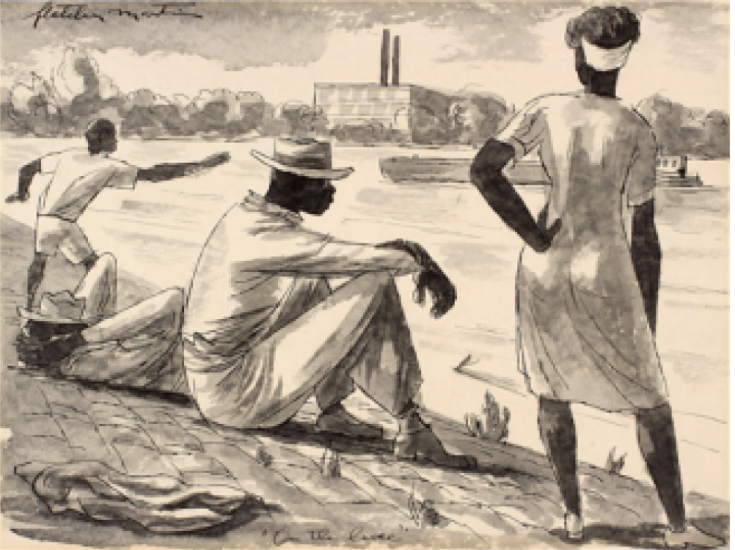
These observers – the holders of this river – are relaxed, they find a sanctuary by the cleansing water. Where did they come from, and where will they go next? To them, these questions may not matter, as they are where they need to be in the present moment — together, facing their home. They remain on the levee – a representation of human will and need – trust, rest, being. Some feel we have to monitor and control the water; make sure it doesn’t rise above where it belongs, flooding into a world it may break open, revolutionizing the way it’s always been. But these four are different, they equally reside in tandem with the river, not against it.
The levee is a temporary – and at times unpredictable – structure that is slowly broken down as the river grows, recedes, erodes. It is the antithesis of an uncontrollable river that follows a natural pattern. Here, the levee is a boundary that the Mississippi river will dare to cross, should dare to cross – as a river belongs anywhere, it holds no boundaries. The only boundary is defined by the levee. What does this levee hold? Maybe the ground, the warmth of the sun, the ideas of the builders – it also holds these four. The levee holds their bodies, their minds, their ambitions, their worries, as they behold the Mississippi river – from afar.
Kennedy Phillips is a recent graduate of the University of Missouri, Columbia, where she earned a B.A. in English and Creative Writing. A budding poet and creative nonfiction writer, Kennedy is passionate about exploring themes of identity, justice, and belonging – always searching for inspiration in the quiet places.
 After the Art