by Jenny Apostol
During the pandemic, stuck at home like everybody else and addicted to television, I binged a gritty French police drama called Spiral. I never watch cop shows; Spiral is horrendously, graphically violent. Yet I couldn’t stop. Tacking Law and Order-style between chasing criminals in seedy precincts and the bureaucratic scheming at the Palais de Justice offered a new take on Paris. But it was the ensemble cast that drew me in; at the center, a radiant, obsessive detective, Capitaine Laure Berthaud.
Berthaud is ruthless in her pursuit of justice, willing to break any rule to put men who hurt women and children behind bars. I admired how the character feels compassion for victims yet remains centered in her own power. Caroline Proust, the actress who portrays the detective, is beautiful in a disarming way that heightens the intrigue of the show. Why is this woman running a crime unit? Nothing must cloud the capitaine’s judgement or slow her down, certainly not the men in her life. Her affairs (with colleagues, where else do workaholics find dates?) are merely to “blow off a little steam.”
Swap out the degrading police environment, and Laure Berthaud could be a stand in for almost any career-focused woman of my generation, caught in the yin yang of loyalty to job versus oneself. And Berthaud’s wardrobe: black jeans, scoop-neck T shirts, hair pulled back into a ponytail—is exactly what I’ve worn since high school. Like a child dreaming of what to be when she grows up, I imagined myself as a Parisian police detective. No make up. Sensible shoes. Nothing to embellish her person.
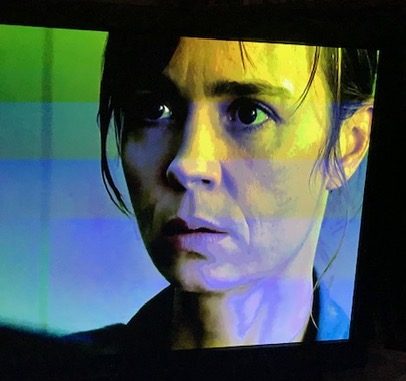
I watched all eight seasons of Spiral — 84 episodes filmed over 15 years — in fewer than four months. Within such a compressed timeframe, the characters aged before my eyes. Years passed over days as their eyes sank more deeply, their expressions grew puffy and jubilant less often. The actors looked as if the stories they dramatized on screen were real life tragedies inscribing their faces. By the end of the run, even the main actress began to show hints of a very particular sign of age: just above her graceful neck, along either side of her jaw, the tiniest bit of flesh was beginning to droop. I never would have noticed except it was happening on my face. I’d already blown through important deadlines involving moisturizer and exposure to sun. What grief or joy did the creases colonizing my skin betray?
I still felt young (sort of), yet I couldn’t quite cop to turning age sixty. In my youth, physical beauty offered a solution to a range of social and professional challenges. Vanity would only admit my age if I didn’t look it. My daughter thinks this is ridiculous. Women have been manipulated into believing that power resides in our looks, accommodating a patriarchal superstructure imposed on our bodies.
Put another way, if I didn’t look old, I wouldn’t have to face all my projects. My writing. The de-assembly of a life and the paring away, death cleaning verging on actual death. What hadn’t I achieved while my face looked clear each morning, full of hope, nothing hidden? I wasn’t ready.
In the real world of my D.C. suburb, we were entering the second year of time standing still. The daily tragedies upending lives around the country and the world had spared my husband and me. We had food. We commiserated outdoors with neighbors and friends. Our kids came home from college when campuses shut down. Even my YMCA remained open by appointment. But we were all losing people to Covid. First, an old friend from New York I hadn’t spoken to in decades. Next, the woman who helped raise our children passed away in hospital, unable to recover even with life support. Someone’s mother died in another state. A friend lost both of her brothers. We attended memorials in person and on Zoom. Two beloved teachers gone from cancer. A college boyfriend. Each death spiraled me back to the various people I used to be.
The original title of Spiral in France is Engrenages, which means “gears.” In the play on words is the idea of enmeshment; trapped inside a web of corruption and violence no one escapes. Staring night after night at the sunny, supple, younger-than-me police captain who moved through the city with no strings attached, I saw her as invulnerable. No way she’d let down her guard, it was a matter of survival. But midway through the series, she falls in love with a specialist in the bomb squad. When the worst comes to pass, Berthaud finally breaks. A total unraveling from grief compounded by regret. Seeing this woman confront such a dramatic loss, something broke inside of me, too. Beyond its epic brutality and unapologetic darkness, Spiral had become a story about time; its relentless forward motion dragging each of us along chipping and scratched like old pottery.
*
Jamel Brinkley’s short story “Arrows” takes place as the narrator, Hasan, is moving his father into a care facility before selling the family home. Neither the father nor Hasan’s young son welcome such a drastic change. And certainly not Hasan’s mother, Helena, who died in a car crash yet still commands the family — as a ghost — from the sanctuary of her bedroom. ‘“You have license to do whatever you want with the house, even if that means taking my man away from me,” she argues with her son, “but I am not giving up my room.”’ Hasan is trying to be pragmatic, to face the facts of his father’s age and disability; the old man has gone blind and can no longer manage by himself. Yet it’s Hasan who’s out of step, who sees only what he wants to see while ignoring the tide of loss and sadness rushing at him from all sides. “I was the only one there who hadn’t been granted any exemption from time; the only one for whom the pressure of tomorrow would not even temporarily relent.”
When he was young, Hasan held conversations with an intimate from the spirit world: “I would ask her what she thought the qualities of my own ghost would be. She would say I might be the first person in history who would shatter into ghostliness, producing not one but many. I would ask why, and she would say, You’re full of arrows, Hasan, you just can’t let anything go.”
Near the end of my mother’s life, I could not bring myself to say to her, it’s okay, you can let go now. Each time I was leaving her side, her eyes searched mine, as if she were drinking me in. My whole life was hers, the sole child she’d created out of her own body. I would lean in close, holding her cool, bony wrist in my hand, yet no words came. Like Hasan, I couldn’t face the reality of my mother dying. I left her apartment and missed the moment entirely.
Women I know feel all sorts of regrets—for not having been a good enough lover or mother or daughter. For the way they did or did not build a career. One friend tells me she did certain things so she’d never regret not doing them. I’d been cautious, held myself back. The past is the one thing that can never be altered. I already knew this, yet I hadn’t planned for how it would make me feel.
Abandoning who you truly are is the epitome of ghosting yourself.
The end of the Spiral series brings the kind of closure any working woman deserves. By doing the time, you figure out who you are, what you’re capable of. Then you get the fuck out. Retire from the force. Traced across the features of Proust, the Spiral actress: knowledge the character gained working all those cases. A capacity for tenderness alongside a measure of humility about perilous outcomes. To accept what is.

A friend tells me a woman she knows, also in her sixties, claims, “There’s nothing about aging I don’t like.” We are both agog at this statement, reeling off any number of setbacks from sore knees to restless sleep. Aging is not cancer, which both my husband and I survived, isn’t that the more important thing? During the pandemic, hearing the hourly alarms and jolted by news updates, Spiral became a showcase for resilience, our chief antidote to both Covid and Trump. There was value in escapism, to call back an earlier time when we moved through the world intuitively, not yet interrogating our intentions for our time left on earth. The harder work would be to stop leaving things unresolved, un-felt. To forgive then remove the arrows one by one. Get out of their wobbly, inevitable path.
“Arrows” from Witness by Jamel Brinkley. Farrar, Straus and Giroux, New York, N.Y. 2023.
Jenny Apostol’s essays and poetry have appeared in The Kenyon Review, The Washington Post, Brevity, Speculative Nonfiction, Cordella Press, Blood Tree Literature, Dorothy Parker’s Ashes, Metalsmith, and other publications. She earned an MFA from the Rainier Writing Workshop. Before that, Jenny was an executive producer for National Geographic Channels. You can find Jenny’s work at jennyapostol.com
 After the Art