by Dian Parker
‘Tis the season of freshly picked asparagus. My neighbor has a thirty-year-old crop with thick stalks and plump heads. She has so much that she invites me to come and pick every day. I do; I most certainly do. Only half goes into the basket, the other half in my mouth, crisp and sharp yet oh so delicate. Once home, racing to insure the freshness, I place them in a steamer for no more than three minutes, then into a bowl dolloped with butter and sprinkled with salt. It’s the whole meal. Sometimes if my partner is particularly hungry (all the time) I’ll also cook al dente thin spaghetti (six minutes).
I’m not the only one ravenous for asparagus. Proust adored the kitchen maid’s cooking and loved watching her in the scullery of Combray: “…what most captured me was the asparagus, tinged with ultramarine and pink which shaded off from their head, finely stippled in mauve and azure, through a series of imperceptible gradations to their white feet with an iridescence that was not of this world.” He goes on to compare these delicate colors with the earliest dawn and blue evening shades. My evenings in Vermont are mixes of Payne’s grey and lavender.
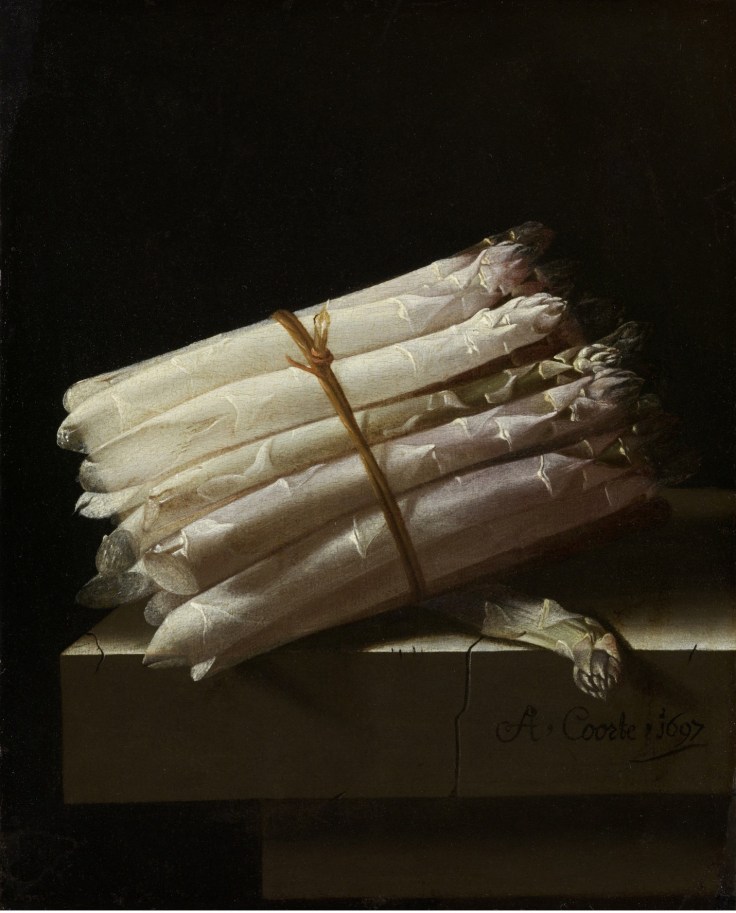
Preparing freshly picked asparagus and reading Proust’s Swann’s Way nudged me to seek out a painting I once stared at for a long time in the Rijksmuseum, Amsterdam. Adriane Coorte’s Still Life with Asparagus, 1697, is less than 10 x 8 inches, oil on paper on mounted panel. The work is as indelible upon my palette as last night’s dinner of asparagus. In his painting, the asparagus are younger than I pick them and therefore pale, almost white, tinged with evening’s mauve. Tied in a sweet bundle, the asparagus is almost resting on a table, with one that escaped the bunch. The whole is backdropped in black, as if nothing else existed but this bundle of juicy goodness. In the Rijk, the painting stopped me in my tracks one hot summer’s afternoon. I fell into a reverie that revisits me every time I look at the image.
Which brings me to the butter, another essential component of this missive. My partner loves to slather butter on the hot asparagus. I’d be happy to just eat them plain but I must say with the added buttery yellow over the deep green shine of gently steamed vegetable, the two make a stupendous composition. Another writer that writes ecstatically about food is Henry James. Here he is extolling the glories of butter in his A Little Tour in France: “It was the poetry of butter, and I ate a pound or two of it; after which I came away with a strange mixture of impressions of late gothic sculpture and thick tartines.” Gothic sculpture and toast?
Years before the asparagus drool, I saw at London’s National Gallery a hunk of creamy butter and two white eggs, which made me leave the museum toute de suite in search of breakfast. It wasn’t exactly what Henry James described, “– the best repast possible – which consisted of simply boiled eggs and bread and butter.” English breakfasts don’t quite match up to the French.
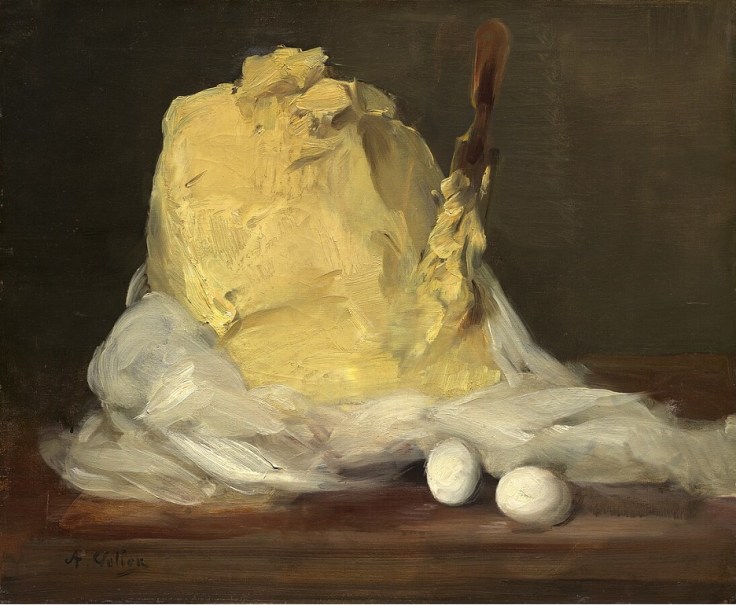
Vollon’s painting is so rich, so hunky and thick, so creamy and, well, buttery, it urges one to purchase (if you can find one) a butter mill to churn your own cream. But then you’d have to get a Guernsey cow, a field, a barn, and milk her every morning at dawn and most likely during the evening’s palette as well.
In this painting, there is again that deep inky black background which shows off the diaphanous dress that the butter floats within. Even the table is barely there, but then who needs it? We just need the crusty bread to slather the butter on. Even the knife is coated in butter needed for the slathering.
Combine these two paintings together and you have the perfect marriage of French Proust with the terribly British Henry James even though he was an American. Coorte and Vollon belong together too, side by side, on a massive burgundy wall, all by themselves. Preferably in my house.
Dian Parker has been published in New Critique, Yolk, Amsterdam Review, 3:AM Magazine, The Rupture, Anomaly, Epiphany, Tiny Molecules, among others, nominated for a number of Pushcart Prizes and Best of the Net, shortlisted for The Masters Review’s 2024 Reprint Prize, an Honorable Mention for Fish Press, and awarded an Artists Development Grant. She also writes about art for the Observer, ArtNet, and other arts publications. www.dianparker.com
 After the Art