by Daniel Barbiero
I first saw, really saw, Jean-Honoré Fragonard’s Blindman’s Buff by accident. It was a Sunday, and I was at the U.S. National Gallery of Art. This was during a period when I had just gotten out of college and was working a low-level, six-day-a-week job, with Sundays being my only day off. As I had no commitments or personal attachments then, I usually spent them at the Gallery. I was on my way to the East Wing and its collection of twentieth century abstract paintings when I caught a glimpse of a painting that made me stop and walk over to take a closer look. It was the Fragonard.
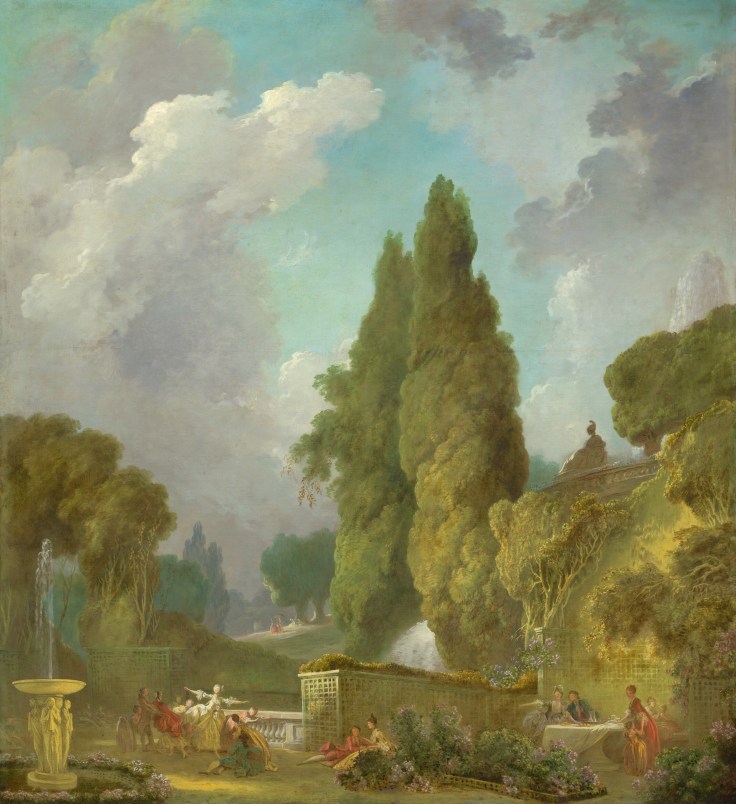
Blindman’s Buff is a large-scale oil on canvas work, probably dating to the late 1770s. It shows the titular game being played by young aristocrats in an expansive garden or park. The players are small figures in the foreground; other than the blindfolded young woman who appears in a shaft of light just left of center, the other people in the picture are semi-obscured in shadow. The landscape surrounding them is lush with bushes and trees – particularly two tall cypresses at the center of the canvas — while the sky above and behind is a light blue patched with wisps of off-white and light purple-gray clouds. It appears to be near twilight. Although its purported subject is an amusement of the aristocracy in pre-revolutionary France, the painting reads instead like a landscape. The garden, which may have been modeled on the gardens in the Villa d’Este in Tivoli, which Fragonard knew from his time as an art student in Rome, has an untended look despite its containing such contrivances as a statue, fountain, balustrade, and other structures.
Eighteenth century French painting wasn’t something I ordinarily liked. In fact at the time I actively disliked it. I was a partisan for postwar abstraction – why would I stop to look at a pleasant scene of ancien régime France, which I ordinarily would find aesthetically frivolous, not to mention ideologically suspect?
It was the power of the landscape that drew me in. I found something both absorbing and disorienting about it. Why exactly that was was something I wasn’t able to articulate at the time – I didn’t have the conceptual vocabulary or the ability to recognize the emotion for what it was – but I knew it had to do with the way Fragonard depicted the human figures’ surroundings, particularly the cypresses and the sky. They dominate the painting, dwarfing the people playing and lounging beneath them. The natural setting as a whole has a certain untamed gravity, largely thanks to Fragonard’s relatively loose brushwork and handling of form and color, that contrasts with the frivolity of the game being played. The clouds and shadows introduce an element of instability into the scene’s emotional atmosphere, while the sky seems to extend indefinitely upward. I could get lost in Fragonard’s overgrown garden, not only in the sense of being drawn into it, but also in the sense of feeling a vague unease and disorientation. It wasn’t until many years later, after reading A Philosophical Enquiry into the Origin of our Ideas of the Sublime and Beautiful by Fragonard’s contemporary, the Anglo-Irish philosopher Edmund Burke, that I was able to understand my reaction to the painting.
Burke defined the feeling of the sublime as consisting of a “sort of tranquility tinged with terror” which in its “highest degree” is awe or “astonishment.” It is a feeling produced, he thought, by our encounter with certain qualities of a natural scene or an artwork, which he catalogued and attempted to analyze. Among these qualities are vastness, depth, infinity, and magnificence – all of which can be found in the landscape and sky in Fragonard’s painting. Vastness and depth are particularly apparent in Fragonard’s landscape. They are encoded in the height of the cypress trees, the painting’s successively distant series of one near and two farther backgrounds, and in the swath of sky layered with clouds. The human figures are swallowed up in the scale and mass of a seemingly infinite, quasi-wilderness. This quasi-wilderness, in addition, embodies the kind of magnificence Burke described as consisting in a “profusion of things” whose “apparent disorder” or “confusion” makes for a kind of “grandeur.”
Writing about thirty years after Burke, Kant in the Critique of Judgment provided a farther-reaching analysis of the idea of the sublime. Like Burke, he distinguished between the sublime and the merely beautiful, and found in the former that “which is absolutely great“or “in a formless object, so far as in it or by occasion of it boundlessness is represented.” With the idea of boundlessness, Kant, it seems to me, identifies and succinctly expresses the most salient feature of the sublime, and sums up in one word the most powerful quality of Fragonard’s landscape. Paraphrasing Burke and Kant together, I’d say that the sublime arises through a confrontation with something of such scale and limitlessness that it overflows our ability to come to terms with it; its effect is to bring on a kind of emotional vertigo in which we experience something of an imaginative abyss. Or, as Burke put it, it has the “tendency to fill the mind with that sort of delightful horror, which is the most genuine effect, and the truest test, of the sublime.”
But how could Fragonard’s picture of a pleasant garden party open up such an abyss and produce a “delightful horror”? I believe it has to do with a kind of projection on the part of the viewer, in which he or she naturally and unconsciously identifies with the human figures as they are overwhelmed by the size and reach – the vastness, depth, and boundlessness – of their natural surroundings. They have the appearance of being extras in a larger drama that overshadows them. This drama consists in the contrast between the landscape’s mute plenitude of being and the human presence, which it reveals to be superfluous and insubstantial. The figures’ insignificance relative to the natural forces around them is an implicit indication of their finitude – a hint of the non-being inevitably hidden at the core of their being. Compared to the powerful mass of natural elements, human being seems to be just a temporary and minor eruption out of non-being, which will get in the last word. This recognition ultimately is the source of the terror of the sublime. It confronts us with the possibility that in effect, we’re just a comma of sensation, instinct, and consciousness inserted within an infinite stretch of nothingness. Of course, when I was looking at the painting, none of these thoughts had occurred to me, at least not in this explicit form. My reaction had been entirely intuitive. My ability to understand and articulate what that reaction entailed only came later. Much later, as it happened. But that’s how the sublime is supposed to work. From an initial affective response, we discover its full effect through subsequent reflection.
Did Fragonard intend Blindman’s Buff to be a painting of the sublime? I doubt it. It seems to have been meant as a decoration for the wall of a salon; it was just something pleasant to look at. But that doesn’t prevent it from taking on another, albeit unintended, meaning. That unmeant but nevertheless present meaning is encoded in the pictorial language of the painting, which is capable of generating meaning on its own account – an example of what Umberto Eco called the intentio operis, or the work’s own intention, which is more or less independent of the artist’s intention. The meaning of an artwork is an open possibility because the relationship between what its creator wishes to express and what its formal and material dimensions are capable of expressing, is essentially dynamic and subject to the active interpretation of its viewers. It’s possible for us to see something in a painting that the artist didn’t mean to put there, but is there nevertheless.
Although I’d gone to the National Gallery in order to see its display of postwar American paintings, I ended up looking at a very different kind of painting instead. Was it really all that different, though? Yes, to the extent that it is an 18thcentury representational landscape, and the other paintings are 20th century abstractions – two very different formal vocabularies. But as the critic Lawrence Alloway argued in “The American Sublime,” certain works of postwar American abstraction do in fact contain some of the qualities Burke identified as productive of sublime effects. In effect, they may not be as far from Fragonard’s painting as their immediate appearance would suggest. As I discovered that Sunday many years ago, one just has to be open to recognizing it.
References
Lawrence Alloway, “The American Sublime,” in Topics in American Art Since 1945 (New York: W. W. Norton & Co., 1975).
Edmund Burke, A Philosophical Enquiry into the Origin of our Ideas of the Sublime and Beautiful, edited with an introduction and notes by James T. Boulton (Notre Dame, IN: U of Notre Dame Press, 1968).
Immanuel Kant, Critique of Judgment, tr. and with an introduction by J. H. Bernard (New York: Hafner Publishing, 1951). Originally published 1790.
Daniel Barbiero is a writer, double bassist, and composer in the Washington DC area. He writes about the art, music and literature of the classic avant-gardes of the 20th century as well as on contemporary work, and is the author of the essay collection As Within, So Without (Arteidolia Press, 2021). Website: danielbarbiero.wordpress.com.
 After the Art