by Darryl Whetter
Silence is so accurate.
—Mark Rothko
How do we know when it’s love? The expansion, excitement and infatuation, admiration running into adoration—we’re tugged by that private gravity, sure, but there’s no clear line, no graduated color-bar or confirming ping announcing we’ve officially tipped over into Love. In Houston, at his Chapel, Rothko’s ghost also asked me whether it’s good or bad that by the time I said I love you to the fourth woman in my life, roughly a partner a decade for my twenties, thirties and forties, I’ve always been the first in the relationship to say it? Am I the brave celebrant or leading a press gang? The vanguard or the jailer?
Rothko’s gauzy color-field paintings, concentrated in Houston’s custom-built Chapel, that art black hole, chart doubts like these but also transcend them. The mauve panels in two corners, that battered lilac unseen elsewhere in his oeuvre, that moan punctuation might just be the breath of love. After six months together, Gisèle and I drove west from Louisiana, where she was finishing her doctorate, into contentious Texas to find out. Canadians GPSing our way through the unassuming streets of Houston’s Montrose neighborhood, bungalow after bungalow on gridded streets, we stopped, how anti-climactic but necessary, how, in ways, relationshipy, at a little municipal parking lot.
We climbed out of a ticking rental car into a temperate Houston afternoon and, really, LOVE. In front of the public parking lot was a parkland strip of grass centered, ring on the velvet style, with a serendipitous outdoor pipe sculpture. The car-sized metal sculpture was painted candy-apple red. In a sculpture’s classic manipulation of scale, what locals call The Love Jack is a five-foot by five-foot version of the tiny metal toys once known in North America as jacks. A three-dimensional plus sign, the public sculpture consists of three intersecting and angled metal pipes thicker than most human thighs. As on the old pipe fences you can still find around rural post offices, the end of each red pipe is sealed with a screwed-on metal cap, though these are the size of sandwich plates. No fence I’ve ever seen has each cap thickly embossed with the single word LOVE. The smiles Gisèle and I traded in the bright Houston sun. Heat and red metal.
Stunned by this jaunty example of 1970s public sculpture, we lingered, took the obligatory smiling pix and didn’t quite say everything I hoped we were thinking. Planning the Houston trip, I had thought the particle accelerator of the Rothko Chapel might help me declare love, yet there was LOVE in industrial metal relief. Unlike Gisèle, that Chapel virgin, I gambled that two Rothko art birds in the bush up the street were better than the sculpture at hand.
Only in writing this did I learn that the sculptor’s name is, no joke, Jim Love.
II.
Like fiftysomething me, Houston’s Rothko Chapel was opened to the world in 1971. The free gallery is open to the public 365 days a year. Although it’s impossible to ignore the Barnett Newman sculpture Broken Obelisk and its reflection in an adjacent pool out front, without them the small unassuming ‘chapel’ building of simple ochre brick looks, from the outside, no more exciting than some pumping station in a city’s water supply. Inside, of course, is the real story.
Multiply fitting that Rothko, often associated with the reds and oranges of what are now known as his Seagram Murals, painted so much black in Houston, as if dipping most of the fourteen site-specific paintings into the oil of his petro patrons. To walk the long sides of his octagonal Chapel, each with three nearly black canvases, is to accrue darkness, smoke billowing along the windows of a plunging jet. Most articles—from a good NPR primer to the tech-porny Architect Magazine celebration of the micro-baffles in the new skylight of a $30-million, fiftieth-anniversary redesign—only mention Rothko’s death, not his studio suicide in Manhattan before the Chapel was complete. NPR lets you know that the youngest of the two children Rothko forsook with a razor blade, his son Christopher, waited until he was in his early thirties before actually stepping into the noise-sucking void created by the Chapel’s dark, abyssal paintings.
Rothko had been the gallery purist who would debate hanging to the quarter-inch and sneak around to find light switches he might dim. When he could finally achieve his life’s dream of having a skylit building designed and created for work he would pair to that space of moving skies, that breath gallery, he killed himself in his Manhattan studio before the Chapel even opened.
III.
I am interested only in expressing basic human emotions—tragedy, ecstasy, doom, and so on.
—Mark Rothko
Thanks to a research grant for my first book of poems, one published a full year before Gisèle and I would even go on our Hmmmm? first-date walk in June, our Rothko trip in November of 2013 was, amazingly, my second international pilgrimage down to Houston for the Chapel. Normally, that’s the kind of art Mecca you only get to visit once in an art-loving life, a hajj down to oil money’s black mausoleum for modern painting.
The Texas oil couple John and Dominique de Menil had visited Rothko’s Manhattan studio at 222 Bowery when he was at work on the Seagram murals he’d soon repossess out of dissatisfaction at their hanging in an ostentatious restaurant, seven courses for the one percent. They agreed with his then radical idea of showing his paintings without a Georgia O’Keefe or Jasper Johns lurking just a few inches away, supported his attention to what he called a “picture[’s] … companionship.” They offered to build him a gallery/meditative space exclusively for his work, new work they’d pay him to make in a space he designed. The rabidly atheist Rothko asked for a chapel. Impish doom.
On my first trip there in 2010, solo and crackling with excitement, I all but leapt through the little anteroom of books and souvenirs for the second door into the sanctum sanctorum. The inner chamber houses fourteen site-specific paintings, the paintings Rothko decided would be his last. Just as I reached for the door handle, what seemed like the only staffer noted, “There’s a prayer group in there, but you won’t bother them.”
They’ll bother me, I knew but didn’t say. I’d flown nearly 3000 kilometers down the central chute of North America, spending what the Beatles so rightly call someone’s hard earned pay with a federal research grant to write fossil poems. The public money focused my hopes and ambitions. Finally, a chance to write about Rothko’s Chapel, that fossil oven, but what to say?
I didn’t admit it for another two years, but fossils and Rothko’s weren’t the only extinctions that first drew me there. I’d flown down from the tail-end of a trip with my penultimate partner, Nadine. Too predictably, and too briefly, a trip of ours through the Canadian Rockies had indeed lifted our silently dwindling hopes about a relationship we were both secretly beginning to admit was also on its plunge toward death. Unlike the second time I stood in the utterly unique art space of the Rothko Chapel, I first saw and contemplated his paintings alone. Well, eventually alone.
Within seconds, my first inhalations of those seared paintings were infected by the prayer group’s … confession circle? sharing circle? circle jerk? I can’t get out of this pattern of judging myself. I’ve just got to let myself … be less narcissistic? Think of others? I started scribbling in my notebook, the first scratches that yielded my first Rothko poem, but the self-obsessed prayer circle kept yanking me out of the quietly pulsating paintings, kept, admittedly, putting their self-obsessing ahead of mine. I reached for my noise-cancelling headphones, which Gisèle and I now more truthfully call my humanity-cancelling headphones. A previously unseen security guard materialized, Batman-style, as if dropped from the ceiling. She reminded me that the Chapel was a “technology-free zone.”
The security guard and I were wearing shoes and watches. Her pants, like mine, had a button and a zipper. My notebook and pen, I didn’t quite point out, were clearly technology. Reading my look, she added, “It’s their final bit. Ten more minutes, max.”
Should you have the joy of seeing what are now known as Rothko’s Seagram Murals, bequeathed by the William-Turner-loving Rothko to Britain’s Tate Gallery, your eyes range over pampas of red. At the de Menil’s other Houston gallery—a short walk from the thrumming Chapel—you can see his No. 10, from 1957, his four variations on yellow, or his orange-is-always-a-party No. 21. Look, there, at his austere but aptly named 1956 Plum and Brown, and you can be tempted to think of his oeuvre as a kind of oven burning hotter and hotter as he aged. Aged and/or moved towards suicide. In the color-dark Chapel, a single dark canvas hangs between the humble entrances. Top-heavy with black and framed with the brown of dried blood, suicidal Rothko’s slaughtered hide of Lascaux’s bulls, the painting is a mahogany screen door into the abyss. Not, for some, the first place to declare your love.
But. But. No “but,” no story. Romeo and Juliet love each other but also their blood-feud families. Breaking Bad’s cancer-surviving Walter White wants to provide for the family he might soon leave, but he also wants to be the brain king, Mr. Clever. With an art-gallery/chapel created to house the work of a brilliant painter who slit his wrists as the skylights were being lowered into a building designed to show his work as he wanted it shown, for free and forever, the insatiably dark triptychs that march the Chapel’s long walls can seem, yes, like oil money’s blackened air-raid windows. But the corners, his sly corners, hold five panels which birth a mauve unseen in his well-studied oeuvre. The skin of Concord grapes stretched onto canvas, Keats’s mouthful of burst joy. Churning waterfalls in a lost mountain city of pain.
Like all poets, all artists, my eyes can, and must, uncouple. One eye fixates on the art of others, sees that perpetual gallery of work already done, forever etched. My second eye, though, has to be mine, has to add. Drunk on Rothko and love, on death and love, in the not-quite-good-enough chapel of yet another brilliant artistic suicide, I hadn’t forgotten Jim Love’s bright red Love Jack public sculpture a few blocks from the darkened chapel. Wrong to some, I’m sure, but I held Gisèle from behind for my declaration, encircled much of her in my arms, my chest a wall for her back to lean against, as we both stared at the lavender boxers Rothko had painted into his corners. Pulitzer-winning gay American poet Frank Bidart knows, “The love I’ve known is the love of / two people staring, // not at each other, but in the same direction.” With Gisèle in my arms and Rothko’s lavender weeping on canvases in front of both of us, each of us, I finally, helplessly said I love you. Three years later, we’d marry.
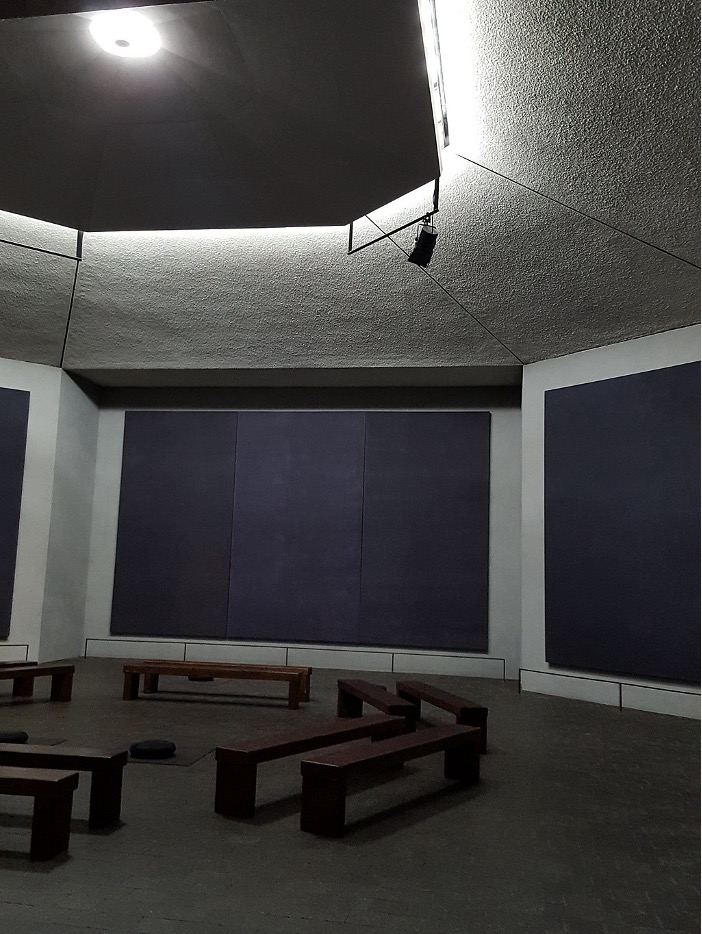
In the Rothko Chapel, the skylight, streaming Texas sky and his bruised paintings unite to make the charged room breathe. Painting after painting, near Gisèle or looking across the hushed gallery at her, I thought, and felt, YES! In one corner, as we stared together into Rothko’s ethereal lilac, I wrapped my long arms around her from behind. (Understand, Brother Rothko, my distraction at the caramel waterfall of her hair.) All breath synchronized, that of the paintings, the louvered, skylit room and this new wonder, Us. “My darling, I love you.”
Darryl Whetter’s ten books include the climate-crisis novel Our Sands (Penguin, 2020) and, as editor, Best Asian Short Stories 2022. Routledge has just released his new anthology Teaching Creative Writing in Canada (2025). His writing has been selected to Best Canadian Stories, Best Canadian Essays, Best Asian Short Stories, etc.
 After the Art