by Sue Eisenfeld
More than a hundred paintings that debuted on the salon walls of the world’s first impressionist show in 1874 found each other again at the National Gallery of Art in Washington DC in September 2024. I went to see the show on October 6, the day before October 7, which was the one-year anniversary of Hamas’s murder of 1,139 people in Israel and the hostage-taking of 250 people, and it was roughly halfway between the two holiest days in the Jewish year, during the Days of Awe.
The painters—Degas, Monet, Renoir, Cezanne, Cassatt—were renegades, the free-thinking flower children of their day, bypassing the traditional art world and its stuffy, juried Paris Salon, which rejected them for their new-fangled ideas, and banding together to show their work on their own terms. They did not believe in art with rules; they wanted to let loose with whimsical brush strokes of texture and motion to create the impression of things—sunsets, waterways, and fields. They did not want to be bound by the heavy darkness of tradition; they wanted brightness and color and surprise. And they did not believe all art should be deeply symbolic with biblical or mythological messages; they wanted to portray regular people doing regular things in a normal life—with grace and dignity and beauty, like a washerwoman bending over ironing clothes, a woman breastfeeding a baby, and dancers prepping for their ballet.
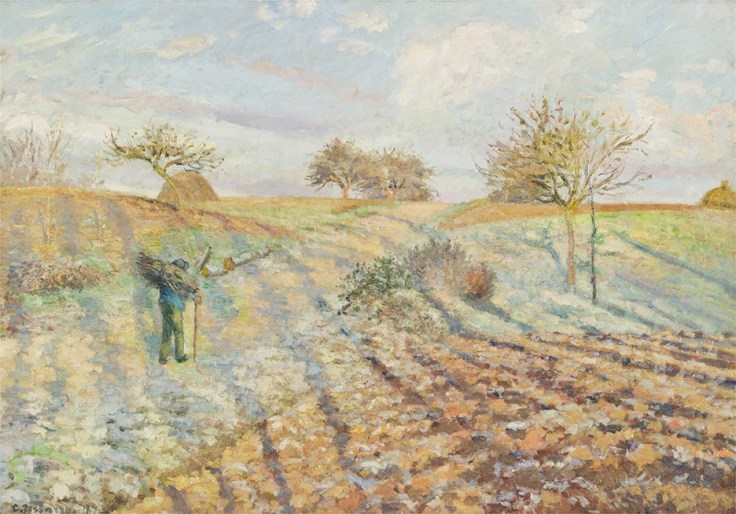
Of the works arrayed across nearly ten rooms, Hoarfrost, by Camille Pissarro, 1873, stopped me in my tracks—first, because of its gorgeous, farmy landscape, a plowed pastel field glistening with morning frost, alive with streaky shadows of the rise and fall of furrows of the land, with a man carrying a bundle of sticks on his back and walking a slow diagonal country road across the canvas; and second, because of the information on the museum label next to the painting.
French, born in St. Thomas, Virgin Islands, 1830-1903. I could already feel the buzz of what was coming next. As I scanned down a few paragraphs, a bio fact not seen on any other wall plaque was written: A Jewish immigrant from the Caribbean.
My fascination with the diasporic Jews of the Caribbean began in 2003, when, on a day trip from a vacation in St. John, I made the journey to St. Thomas, to Charlotte Amalie (the city where Jacob Abraham Camille Pissarro was born), to see the oldest synagogue in the Western Hemisphere.
The Hebrew Congregation of St. Thomas, founded in 1796 by nine Jewish families of Spanish and Portuguese descent, is a place whose floors have been covered in sand since it was built in 1833. The congregation wanted to remember their Inquisition history from the 1490s and the three centuries that followed, when the Jews of Spain and Portugal used this insulating material in their secret places of worship to muffle the sound of their prayers when they descended into basements, hiding their true selves from those who wanted to forcibly convert, expel, torture, or murder them, often in spectacles of public burning.
Pissarro, a descendant of Jews who fled Spain and Portugal and made their way to St. Thomas in 1655 for its freedom of religion, suffered more than many of his artist contemporaries from the unrest and destruction in from the Franco-Prussian War (1870-1871). When the armies of Prussia and Germany invaded France, he and his wife and child fled their home in Louveciennes, a Paris suburb, and Prussian troops commandeered the house and destroyed…the furnishings [and] also, most devastatingly, much of the art he left behind. When he returned to his home many years later, he found hundreds of his paintings pillaged by his neighbors and destroyed by soldiers who had laid them in the mud to provide paths from his house to the road, a cruelty that could be seen as a sort-of precursor to the Nazi-looting of Jewish art six decades later.
With little inherited wealth and a growing family, he struggled most of his life to make a living and advance his career, the text went on. Nevertheless, he served as Cezanne’s instructor and mentor and became known as “the father of impressionism,” “the dean of impressionist painters,” even as the public and the critics of 1874 were “horrified” and called the innovative new style introduced at the first impressionist exhibition “vulgar,” “commonplace,” and “awful.”
Pissarro’s heritage and the lesser-known history of the Jews of the Caribbean and the Jews of the Inquisition isn’t just a far-away, long-ago phenomenon. The first Jews in the United States—who arrived in New York (1654), Rhode Island (1658), Charleston (1690s), New Orleans (1724), and Savannah (1733), for example, were Sephardic Jews who had fled to and then from the Netherlands or Central or South America, often coming through the Caribbean. They came for the safe haven and religious freedom and personal rights extended to them in our early nation after centuries of living in places that destroyed synagogues, put Jews in ghettos, removed Jews from public office, prevented them from voting, prohibited them from owning land, made them wear badges marking them as Jews, and other controls on their lives.
It’s a history I ran into again in 2022 when I vacationed in Nevis, part of the island-nation of St. Kitts and Nevis. There, I engaged in a scavenger hunt of sorts in Nevis’s capital city of Charlestown, trying to find the old “Jews’ School” and “Jews’ Synagogue” with its ritual bath, from when the Jews first arrived in 1677 after Brazil expelled them or after they left the Netherlands or Hamburg by way of Barbados. One day I found myself unexpectedly leading a tour of the 1679 Jewish cemetery near an alley known as “Jews’ Walk,” now labeled “Jew Street.”
I had paid a hundred dollars to be on the walking tour of the city, but when I realized I knew more about the history of the cemetery than the guide, I led the small group from grave to grave with my hand-drawn map and read the translated Portuguese and Hebrew epitaphs in English I had queued up on my phone. Grave of the blessed Abraham Cohen Lobatto, who died January 5450 [1690]. May his soul enjoy glory. Grave of the virtuous spinster, Rachel Cohen Lobatto, who died on the 8th of Tishri 5462, corresponding with the 28th of September 1701. Grave of the blessed, of Daniel Mendes, who enjoys glory, died on the 28th of Tammuz 5444 [July 10, 1684]. There lie Ester Marache (d. 1679), Ribca Levy (d. 1687), and Abraham Abudiente (d. 1689), as well, among the handful of horizontal crumbling granite stones, evidence of the small Jewish community that had once found refuge there and thrived until about 1765.
Even in the islands that had welcomed them, though, Jews would be called “foreigners and strangers,” blamed when the economy slumped, “charged with taking the bread out of the Christians’ mouths,” and called “the true cause of the strange decay of this place,” according to The Jewish Communities of Early Colonial Nevis: A Historical Archeological Study, by Michelle M. Terrell. I pulled this book off my shelf after seeing Pissarro at the National Gallery, and before the first page of her text begins, she presents a timeline that reminded me that the history of hate against Jews is long: “135 – Jewish diaspora out of Roman Palestine…1290 ‒ Jews are exiled from England, 1306 ‒Jews are exiled from France…”
Two of the people on the tour in Nevis were an older couple, maybe early 70s, and when we got to talking, we found that the man and I were both from Philadelphia. “What neighborhood are you from?” I asked him, and he explained that his family once lived in Queen Village. My great grandparents and their families had lived there too, and I knew from recently reading the history of Philly’s “Jewish Quarter” that this was where the third wave of Jewish immigrants to this country—those escaping pogroms from Eastern Europe and Russia—had settled after arriving through the Port of Philadelphia. Integration and desecration meant that several of the old synagogues, including one with a golden dome, have been remade into condos and apartment rentals. I asked the man if he had ever partaken in any of the Russian baths, built to serve the Jewish immigrants who lived in homes without running water. He had—as had my father with his father in the 1960s—and we recalled together the places where Dad had told me the old Jewish men were battered with oak leaves and branches—a traditional Russian rub-down, then dunked into freezing water after using the steam rooms, which he called “heart-attack city.” The man laughed in recognition.
Across nearly two-thousand miles from our homes in the States, we strangers were not strangers. We shared a history—a recent history and a long history; a history of blood, both DNA and violence; a history of togetherness and a history of otherness. We shared this history with Pissarro too: the artist’s impressionist pals would turn against him eventually—not for his art, but for being a Jew and for advocating for a Jew. In 1894, during the Dreyfus Affair in France (1894-1906), when Captain Alfred Dreyfus, a 35-year-old French Jewish artillery officer, was framed for treason, Pissarro came out in support of the man, while his friends were against him. Cezanne and Renoir, in particular, refused to even greet Pissarro on the street, with Renoir saying of Jews, “they shouldn’t be allowed to become so important in France.”
At the National Gallery, as my eyes swept across the wall of Pissarro’s bucolic landscapes, with the white-flowered orchard trees blooming in the fields around the village of his former home, I looked out among the crowds at all the other people looking elsewhere who amassed to see the new exhibit, who danced the slow waltz from painting to painting and room to room in gaping wonder, and I wondered how many of them there felt the cloud of the past, as I did, heard the echoes of the dark basements, noticed the eerie shuffling sounds in the sand, not knowing what, pray God, would be coming next.
Sue Eisenfeld’s writing has appeared in The New York Times, The Forward, Smithsonian, Gettysburg Review, Potomac Review, Beltway Poetry Quarterly, Full Bleed, and many other publications, and her essays have been listed six times among the Notable Essays of the Year in The Best American Essays. She is the author of two books of creative nonfiction, including Wandering Dixie: Dispatches from the Lost Jewish South, and teaches for the Johns Hopkins M.A. in Science Writing program. www.sueeisenfeld.com
 After the Art