by Liv Albright
I look in the mirror. My chin shrugs. The left corner of my mouth twists into a smirk. An eyelid snaps shut. I look down at white ceramic, so I don’t have to watch my face move against my will, a side effect of Risperdal. Tardive dyskinesia. I started taking the drug in 2019, after a long psychotic episode. I wandered the streets of New York, a floor-length maxi dress collected leaves and crushed food around my ankles as a monologue promising fame drum-circled its way through my mind.
I know I have to be on it so I can write, so the orator of the monologue doesn’t start to shout at me. I remember huddling in my purple armchair, knees to chest, a palm pressed to each ear. Eyes scrunched shut.
I would make myself a cup of tea that would grow cold by the foot of my chair.
I remember and I walk away from my image. I practice gratitude. It could have been worse, I tell myself, you could have been born before the 1950s. You could have been lobotomized.
Most lobotomy patients were women.
Lobotomies were cheap.
They were a quick solution to a problem of understaffed asylums, spilling patients out of doors and windows.
I walk to the Baltimore Museum of Art to see Joyce J. Scott’s exhibit, where I can stare at images other than my own.
I could let my hair down, but I wear it in a tight knot on the top of my skull. It looks like a red slash against the sun. I wear it like war paint.
I feel my chin clench, my eyelid droop. I hold my head higher.
After meandering through sculptures of legs reaching up from the earth, through a grouping displaying a woman and child blown from amber glass, I come across a series about albino killings in Tanzania.
In Tanzania, albinos are butchered. They are hunted by gangs hired by witch doctors, who then mix the albinos’ dismembered parts into potions, which are sold to people seeking success, often to businessmen or politicians. Powerful men with ties and oiled hair who are hard to take down because they are an integral part of the orchestration.
At the height of my psychosis, a psychiatrist—a “whitecoat” in the psych ward—used my paranoia against me. Antipsychotics don’t cause side effects, he said, you’re just paranoid.
But tell me, how can we eliminate paranoia when men in power, in white coats, and politicians, who drink potions made of vital organs, justify our paranoia?
I stare at the beaded head of an albino boy.
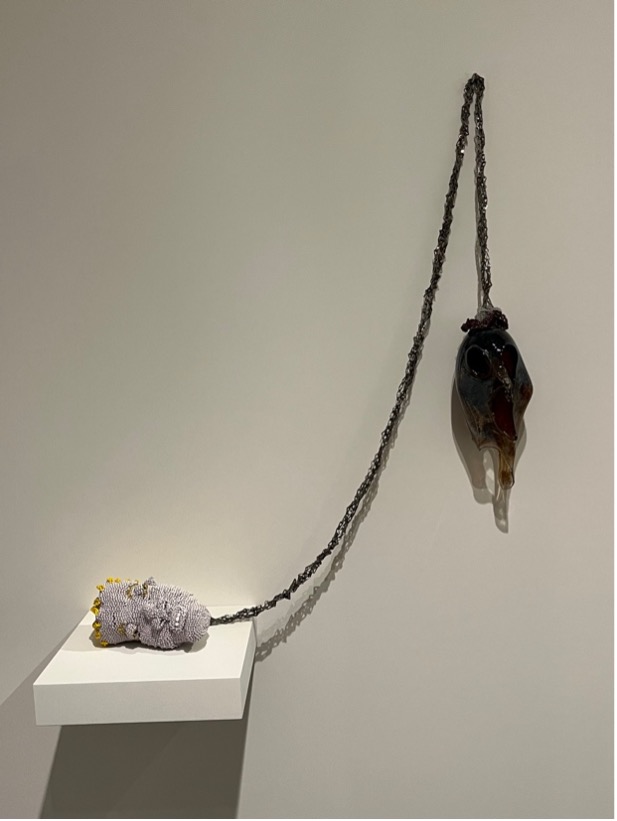
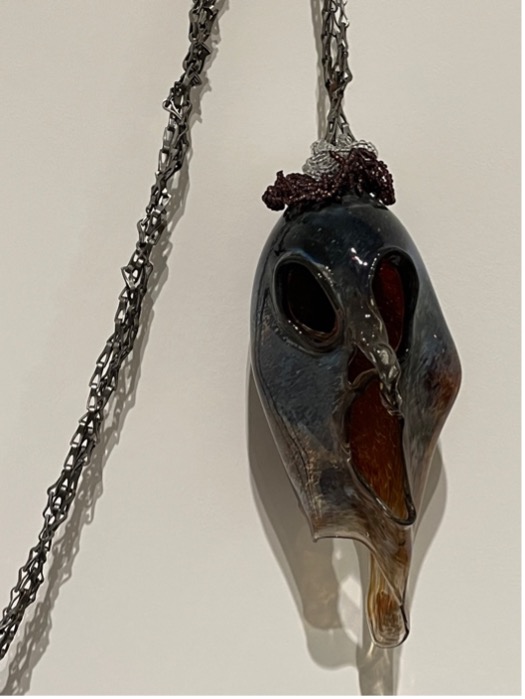
The boy’s head is severed, positioned on its side so we can see his facial expression, resigned to death. I consider the mask, hanging above the severed head, at an angle, and I wonder if it is the mask used to cover the boy’s face in a kidnapping, if it is the mask of a witch doctor, or the mask a kidnapper would wear himself so as not to be identified. The positioning of the mask, higher than the boy’s head, and upright, gives it some authority. It suggests a sort of victory. But like the boy, the mask is suspended, as if on a puppet’s string.
I search the exhibit via Google and find nothing.
I wonder who the boy was before he became a head and body separated by blunt metal. An article in The Atlantic by journalist Alan Taylor shows images of albino boys with missing arms playing soccer. A boy using a prosthetic arm to clutch a teddy bear tight to his chest.
I remember a book I’d read, years ago. Kazuo Ishiguro’s dystopian Never Let Me Go. Ishiguro’s novel is told from the perspective of Kathy H., who happens to be a human clone. She grows up with other clones at Hailsham, a quasi-boarding school in England. The guardians, human adults who watch over the clones, tell the clones in vague terms what their future will hold: they were made from test tubes for the sole purpose of donating their vital organs. However, Kathy H. concludes that they were “told and not told,” always too young to fully grasp the meaning of the guardians’ words. Growing up, the clones heard horror stories, passed down from the guardians, of other clones who tried to escape by way of the mythical woods that surround the Hailsham campus. One boy, for example, was dismembered and hanged from a tree near Hailsham. A lurid warning to any other clones who might want to escape.
Ishiguro poses the questions: what is considered human? What lives—human, animal, or creature—matter? Do some matter more than others?
In Tanzania, albinos are not considered human. They are viewed as “ghosts.”
They are seen as “haunted beings.”
In Ishiguro’s novel, clones are perceived as insect-like. Spiders.
The clones had known they were different from humans, but when they first fully realize this difference, it is in the context of running into Madame, an affiliate of Hailsham, a slender woman who always wore a fitted grey suit. One of the clones, and Kathy’s good friend, Ruth, decides that Madame is afraid of them. They decide to swarm her. Kathy writes:
I can still see…the shudder she seemed to be suppressing, the real dread that one of us would accidentally brush against her…Madame was afraid of us…in the same way someone might be afraid of spiders.
Although the clones are not technically human, they were composed from human beings, namely junkies, prostitutes, and convicts. This adds another layer: while it’s arguable whether the clones are human—they were made in test tubes—they were created from types of people often not considered human. The clones are paired with objects and scenery that indicates that the people in charge of them consider them to be trash: their only personal items are junk, and prior to their donations – medical procedures in which the clones’ vital organs are removed—they move to a run-down barn, not even fit for animals to live in. Interestingly, Ishiguro both demonstrates the clones’ human and inhuman qualities. Kathy H.’s prose is devoid of any emotion: her narration is programmatic, without any element of style to indicate personality. However, the characters she interacts with very clearly experience emotions (as does Kathy herself). Tommy, for instance, Kathy H.’s love interest, has an anger management problem, that Kathy ultimately identifies as a subliminal response to his intuition, that he knows all along that they would grow up – not to work in offices or become drivers as some of them dreamed of – but to be harvested for their organs.
In Tanzania, mothers are told to hide their albino children in the house. There is no dreaming. They live in fear.
The clones don’t seem to experience fear until the very end. In the interim, they absorb themselves in their relationships, perhaps their most human quality. At Hailsham, Kathy H. is close with both Ruth and Tommy, both of whom she ends up caring for at the end of the novel, as doctors work to remove their vital organs, ultimately resulting in their deaths (or what Kathy refers to as “completing,” which could be interpreted as proof of their machine status or, as I prefer to look at it, a way to separate the clones from humans with the barrier of language, robbing them of the right to call death by its name). Bonds like the ones Kathy, Tommy, and Ruth experience, are virtually lifelong, and therefore represent humanity at its noblest. They represent the ideal rather than the actuality: devotedly caring for someone until their death, which more often than not is a futile hope. In this case, the clones’ relationships are possibly superior to those of humans. But perhaps most human of all is Kathy H.’s relationship with Tommy. Out of jealousy, Ruth kept them apart, and, finally at the end, Kathy H. and Tommy are able to develop their romantic bond while Tommy undergoes his second and third donations. Kathy writes that despite their finally being able to have sex, an undercurrent of sadness pervades their interactions: “Tommy’s manner…was tinged with sadness, that seemed to say…’what a pity we left it so late.’”
For many albino boys, it is too late. For some, it’s not.
Alan Taylor’s Atlantic article highlights their humanity.
In one photo, a Global Relief Fund employee, Elissa Montani, delicately holds the prosthetic hand of an injured albino boy. In another photo, the same boy and Montani are intertwined. Montani examines something, a bracelet or a watch, on the boy’s wrist. His body is pressed to her legs, both heads bent over the boy’s wrist. If Montani weren’t identified as an employee, anyone looking would believe that she was the boy’s mother.
As I look at the sculpture, I think of my own mother. I’ll still love you if your tardive dyskinesia gets worse, she had said, holding my hand. I touch my chin. I look at the Joyce J. Scott photo and darkly wonder if someone can fashion a hood for me like that one to hide my face.
In Never Let Me Go, the characters faces aren’t described. Not many physical descriptions are given, but we can assume, since the clones are copied from human DNA, that they appear human-like.
Beneath the sculpture, a quote reads:
How can you look at a person who looks exactly like you
… and see them as something dangerous and kill them?
In many instances, albino children’s parents are involved in their kidnappings. Kidnappings of children, who look, maybe act, just like them.
In Never Let Me Go, the deception of care is present as well.
When Kathy and Tommy confront one guardian at the end of the novel, she responds:
We were able to give you something which … no one will ever take from you, and we were able to do that principally by sheltering you … Sometimes that meant we … lied to you. Yes, in many ways we fooled you. But … we gave you your childhoods.
Perhaps that’s what the guardians wanted to believe, that they were refashioning the donation program, doing heavenly work, but I see it as deception.
The clones didn’t fully understand their fate, just as an albino child whose parent participates in their kidnapping probably can’t comprehend that their breadwinner would turn one of their arms or legs into a cash profit. Like I didn’t understand why the dishonest doctor in the psych ward, who was paid to keep me safe, chose not to explain potential side effects to me.
I sit out in the sculpture garden, let an ant crawl up and over my threaded sock.
I don’t pull out my phone to examine my chin.
I take a deep breath. The doctor I have now is honest. A woman.
If that starts to happen, she said, indicating TD, we can talk about it, together.
I smile at a couple who passes me. They smile back, offer hellos. They don’t seem to notice my chin, my eye. They don’t even really look at me at all.
Liv Albright’s work appears in Harvard Review, Vol. 1 Brooklyn, Chicago Review of Books, Ligeia, Electric Literature, and Full Stop. She is currently writing a fairytale-infused hybrid memoir for her MFA thesis at Goucher College. In her free time, she enjoys painting and playing with her two free-spirited cats.
 After the Art