by Kristina Moriconi
I do not recall where or how I first discovered Adam Shaw’s paintings and sculptures. But I know it was his painting Harbor Dawn I was drawn to first.
And that is the painting that hangs now on my living room wall.

Inspired by, or perhaps in homage to, “The Harbor Dawn” from Hart Crane’s long poem The Bridge, this work by Shaw is layered with language, shrouded in mystery.
It is otherworldly.
Crane’s poem begins:
Insistently through sleep—a tide of voices—
They meet you listening midway in your dream …
My acquisition of Harbor Dawn from Shaw has connected us, two artists living on opposite coasts. Via Instagram and Facebook, I am able to continue following his work.
Most recently, it is Albion Moonlight I’ve come upon, a painting stark and mysterious in its rendering. Bold and riveting in the simple geometry of its perspective. It is as though, in looking, I have no choice but to enter the painting, to walk the wooden planks of this wharf that leads everywhere and nowhere at the same time.
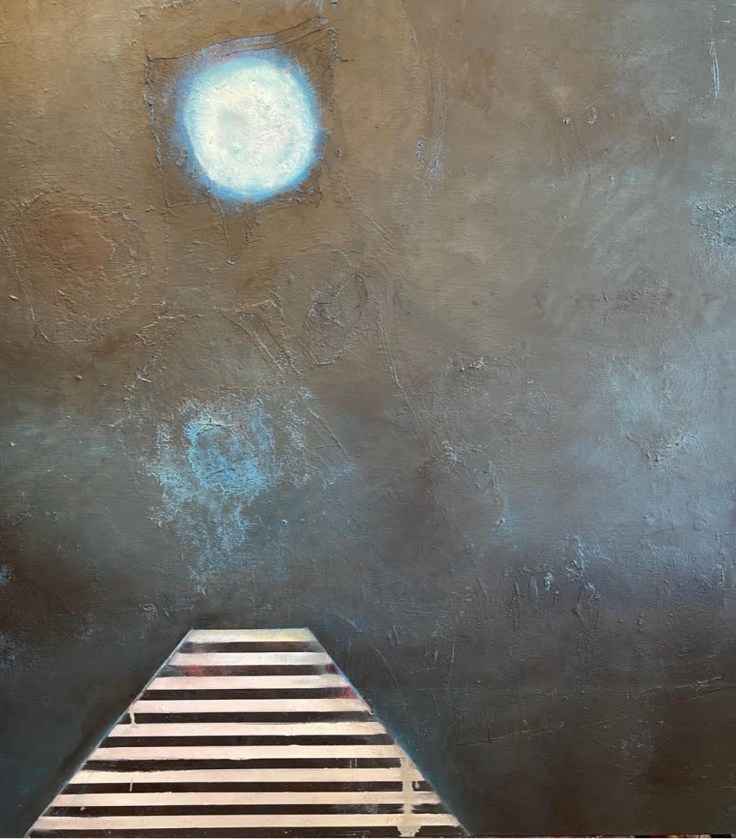
It is this act of entering Shaw’s work that prompts me to retrieve a book from my nightstand, a blue-tasseled bookmark fixed at the start of a chapter I keep returning to again and again. For its evocative voice, for the secret whispered in its language, the rhythm of repetition in its mention of passage into a room:
The first time I entered the room was in a dream … The second time I entered the room, a corpse was waiting … The third time I entered the room I entered in darkness … The fourth time I entered the room I was a thief.
This way both words and visual art can draw us in. Invite us.
Summon us to partake.
When I comment on how much I love Shaw’s Albion Moonlight, he discloses this: “[it is] a painting with literally years of buried images in it.” And he shares one of many earlier incantations he’d photographed, writing: “It cost a lot, emotionally, to paint over a painting like this—and over and over.”
His comment feels like a revelation. It takes me right back to the book I keep on my nightstand, Doireann Ní Ghríofa’s A Ghost in the Throat, how on its pages she sets out in search of the missing pieces of an eighteenth-century Irish poet’s life. What she finds initially is so little it seems as though Eibhlín Dubh Ní Chonaíll had been all but erased. Such loose, incomplete sketches of this long-ago female poet leave her wanting more.
In her search, she finds and connects essential pieces, but she also lets herself depart from this charted path, making space to muse, to digress, to perhaps, and to imagine.
I try to imagine the small treasures of her days, all she saw and took joy in: … The flight of bats and swallows … The branches reaching higher each year, their leaves turning gold, falling, and then budding green again … All the remembered fragments of her dreams…
With this in mind, I return to Shaw’s Albion Moonlight, conjure the images buried beneath layers of paint. I muse. I digress. I perhaps and imagine. I begin a poem, considering what the idea of collaboration might look like. His paintings, my poems.
Possibility.
For now, though, I pause at this place I have found, this sublime intersection of Adam Shaw’s canvas and Doireann Ní Ghríofa’s page, where, though they speak of very different worlds, they have each deeply and rigorously interpreted and rendered the subject of their work and have both fostered a space for curiosity and invention.
Near the end of Doireann Ní Ghríofa’s A Ghost in the Throat, she writes:
My attempt to know [this woman] has found its ending not in the satisfaction of neat discovery, but in the persistence of mystery.
As both a mixed media artist and a writer, in much of her work, Kristina Moriconi explores the relationship between story and image, between the language of metaphor and the possibilities of what can be rendered to communicate it visually. She lives and creates in a small magical town outside of Pittsburgh, repurposing objects and materials she finds in nature, in thrift shops, and in Pittsburgh’s Center for Creative Reuse. She teaches both writing and art whenever and wherever she can. Her lyric narrative What Becomes of a Body is forthcoming with Minerva Rising Press in 2025.
 After the Art