by Matthew E. Henry
In her book Get the Picture, journalist Biana Bosker argues that, among their many obsessions, too many in the art world are invested in finding subtle ways to “Keep out the schmoes.” She would know. Bosker spent five years as a gallery assistant to New York studio artists before becoming a security guard at the Guggenheim. From the physical locations of galleries to the printed text on artist statements and tombstones, she “became initiated into the way that the art world wields strategic snobbery to keep people out.” She documents the difficulties of the uninitiated attempting to enter this “exclusive ecosystem,” this “country club” culture. Even art museums free to the public become “liminal spaces” designed to make most feel unwelcome, on the wrong side of the lintel should they dare wander inside the limestone walls.
In rebellion, Bosker encourages schmoes to engage with art, providing tips “to evade the snobbery” and appreciate art on one’s own terms. Her suggestions include to “notice five things” when encountering a work of art—to ignore the words crafted by the gatekeepers and bask in the visceral. Though the history of the artist and the movement to which they spawned, belonged, or rebelled against are no doubt important and informative, we should ascribe value to our questions as arbiters of our own enjoyment. What drew me to this work? What made me stop in the first place? What details enrapture my imagination? Is there a story I see within the work? Are there familiar characters or settings? Am I transported somewhere else? What emotions does this evoke? Do I want to do something, go somewhere, as a result of seeing this work?
While working on a poetry manuscript, I took Bosker up on her advice and began a tour of art museums across three states. My collection was ekphrastic in nature, responding to mostly literary works, but I wanted to expand into the visual. I wanted to experience original works glimpsed only as reproductions in books and online, and hoped to be inspired by new paintings, sculptures, photographs, and a variety of installations. But I rarely entered this world for the very reasons Bosker detailed, and others she might not have been brave enough to put in print—I have neither the country club vibe nor skin tone typical of such spaces.
*****
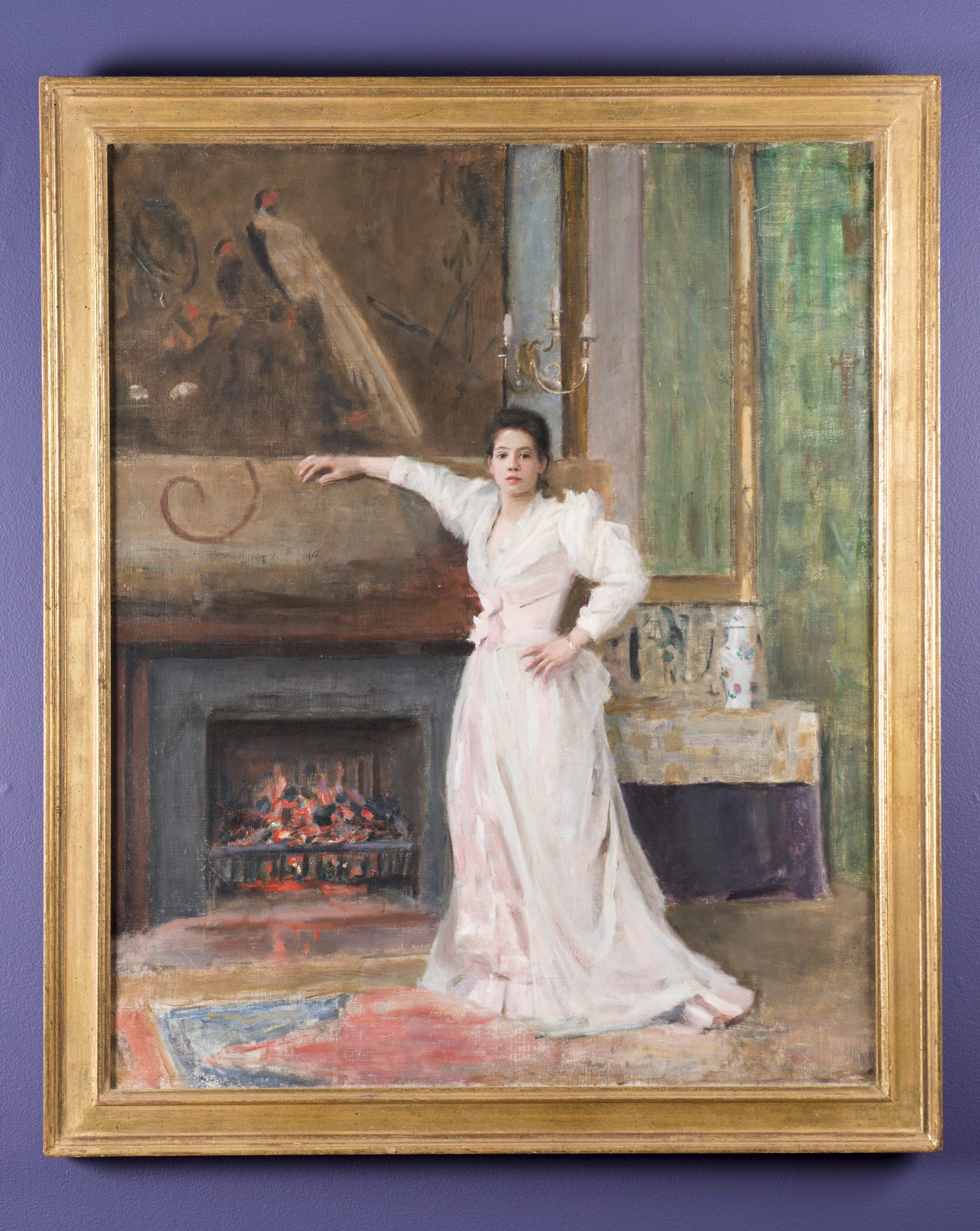
The Portrait of Mrs. E. R. Miller is an oil painting by Eleanor Norcross, the artist and collector of the paintings, sculptures, and furniture adorning the gallery of soft light and muted colors. I stood before her with a notebook and pencil in hand—pen in my pocket after a security guard’s curt admonishment—and set about the work of recording five things, the impressions that may lead to poetry.
Within seconds a thudding shuffling of feet made the security guard’s presence known. I turned to see her back pressed to a blank space on the wall near the gallery’s entrance, untanned arms folded across her chest. Her expression was no more welcoming than in the previous exhibit she followed me from. I recognized the lopsided rise of nose, the half snarl, the furrowed brow of her pale, lined face, just as I have on countless others my whole life. I sighed her out of my thoughts and began to make my notes.
- Miller is a white woman of means and stature. One lithe hand rests on the mantel, the other on her hip. Delicate, but steady. Her presence commands a confidence grounded in the belief of her superior breeding, her place in the world. That one would eventually paint her portrait was a forgone conclusion she impatiently awaited for years.
After a few moments, she moved from the wall to my left—she wanted to be in my line of sight. She wanted me to know she surveyed her domain. Neither her crisp dark pants or her starched but slightly wrinkled white top displayed any official markings of the museum or a private security company. It was the make-work uniform of a volunteer. She probably had minimal training to safeguard what she deemed so personally precious.
- Miller is filling a flowing pink and white dress, rendered in light and airy brushstrokes. Ethereal. The plunging neckline seems almost anachronistic. The bow (ruffle?) below her sternum accentuates the effect, as much as the silver bracelet shimmering on her left wrist—calls the eye back to her hip, her figure. The effect fits her carriage: both posture and sense of importance.
My white shadow cleared her throat and glanced meaningfully at her watch. There was no one else waiting to stand before the painting or in the gallery at this moment. I was in no one’s way but was apparently taking too long. A hinderance to unseen patrons clamoring to appear were I not present. Being an educator for over two decades, I knew how to decisively ignore the passive aggressive behavior of adults and turned my attention back to the portrait.
- The composition’s colors are inviting. The browns, greens, greys, indigo, and blues are the palate of a pleasant dream. The blood orange coals burning in the screen-less hearth warms the rooms in- and outside the canvas, belying their potential danger.
Her walkie-talkie whispers interrupted my thoughts. She called for “additional support…just in case.” She wasn’t sure how long she would need to keep an eye on me and needed someone to cover the rest of her patrol. I couldn’t clearly hear the reply but saw her nod in satisfaction.
- There is a painting above Mrs. Miller’s mantel. A painting within the painting. Two birds of some kind. Black bodies with broad brownish tails, red-throated. They’re perched on an indistiction—the branches of a tree or large shrub. The smaller one (a hatchling?) cants its head toward its mother, awaiting some sign or permission. Whether they chirp in excitement or danger, I can’t tell. Their wings remain mostly reduced, unfurled.
She tensed when I walked to the left of the portrait, then back to the right. Her hand’s sudden jerk to her hip made me wonder about her previous profession and training. Mine instinctively caused me to keep my hands in plain sight, as I surveyed a final feature of Mrs. Miller.
- Her eyes tell a dark and haughty story. They hold knowledge, but also judgments. She’s deciding the worth of the painter and all future viewers allowed in her regal presence, allowed to behold her. Then there’s “the Mona Lisa Effect”: her eyes follow you around the room.
“How the art world excludes you and what you can do about it,” Morning Edition, NPR, Feb 7, 2024. https://www.npr.org/2024/02/07/1227564378/get-the-picture-bianca-bosker-art
Matthew E. Henry (MEH) is an educator, prose dabbler, and the author of six poetry collections. He is editor-in-chief of The Weight Journal and an associate editor at Rise Up Review. MEH can be found at http://www.MEHPoeting.com writing about education, race, religion, and burning oppressive systems to the ground.
 After the Art