by Dian Parker
Henry James wrote fifty novels, twelve plays, many articles and reviews, as well as ten thousand letters. He died in a delirium. Right before he died, he asked for a typewriter, and imagining that he was Napoleon began typing in the air. His last words were, “It’s the beast in the jungle, and it’s sprung.”
Virginia Woolf left a suicide note to her husband, Leonard, then crammed her coat pockets with rocks and walked into the River Ouse. The note in part read: I feel certain I am going mad again. I feel we can’t go through another of those terrible times. I begin to hears voices, and I can’t concentrate. So I am doing what seems the best thing to do. You have given me the greatest possible happiness.
Chekhov wrote over five hundred stories and fourteen critically acclaimed plays. He died of a hemorrhage in the brain due to tuberculosis. Nearing the end, his good doctor ordered a bottle of champagne for Chekhov. “Anton took a full glass,” his wife later said, “examined it, smiled at me and spoke, ‘It’s a long time since I drank champagne.’ He drained it and lay quietly on his left side, soon silent forever. After he was dead, a huge black moth kept crashing painfully into the light bulbs and darting about the room.”
The period between new moons is approximately 29 days. A human head has 29 bones. When I was 29, I had my first of two abortions. The second was almost an exact replica of the first, not the same guy but the same circumstances. New love, leaping attraction, wild and reckless, me thinking I had complete dominion over my body. Both times that I got pregnant, I was traveling in a treeless domain on an 850-cc motorcycle, wearing no helmet, behind gorgeous men, in one-hundred-degree summer, nauseous but I didn’t know why yet. The first time was in Greece, the second Mexico. All of us were hot, and very, very hot.
The difference is that the second abortion woke me up. I knew I didn’t want children from the time I had my first job in theatre at 14. This knowledge has continued throughout my life with no regrets but it takes a lot of hard knocks to stay on track, to face yourself, and I was intent on getting what I wanted when I wanted. It wasn’t until the second time when I was lying on the side of a dusty road in the miniscule shade of the motorcycle suspecting again I’d made a huge mistake, for the second time. This was my penance – heat, nausea, piercing sun, no relief, no compassion for me from me or the men. I’d convinced them both that I was immune to getting pregnant because I’d willed that to be so. After all, I’d gotten away with fifteen years of sex and had never gotten pregnant. But I’d never been sexed like these men, two Herculean beauties.
A painting by Theodoor van Thulden depicts Hercules discovering Tyrian purple, after a drawing by Rubens’ The Discovery of Purple by Heracles’ Dog. The scene shows his dog stained in the mouth and neck with deep red after eating a Nautilus conch shell, with Hercules staring intently at the dog’s mouth. The purple dye actually comes from the murex snail which later was milked near to extinction for this prized color of royalty. The color dripping from the dog’s mouth is clearly not purple but a deep dark red. Venetian Red.
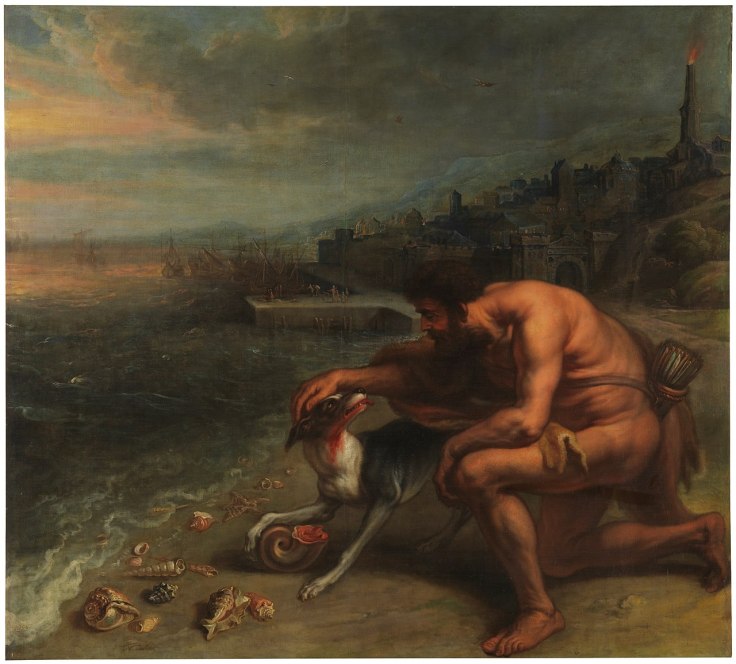
Venetian red has been used in painting since prehistoric time, but the first time the color was named in English was in 1753. Before then, the color was called sinopia. The reddish color comes from hematite which was used as the underpainting on plaster in frescos, discovered when the frescos were stripped from their wall for transfer and restoration. This natural earth clay tinted with iron oxide was mined for centuries from a quarry near Venice, hence the name. The color is found in the 17,000-year-old cave paintings of Lascaux, the Pompeii murals of Italy, and the Cappadocia cave chapels in Turkey that E and I (number two abortion) had hiked hard and long to get to.
The Swiss painter, Félix Vallotton, 1865-1925, realized an oeuvre of 1700 paintings, 250 prints, 1000 magazine and book illustrations, three novels and eight plays, as well as fulfilling many ephemeral and decorative commissions. One of my favorite paintings of his, The Red Room, Etretat (La Chambre rouge, Étretat), 1899, depicts a woman watching a very young child tearing up a piece of white paper. The baby wears a pink smock. The clock on the mantle shows twelve-thirty. The woman, the chair in which she sits, and the walls of the room are saturated in Venetian red.

A classic “mother and child then – objects of universal veneration,” as Virginia Woolf wrote in her book, To the Lighthouse. All seems calm. The child is occupied and the mother keeps watch, garnering a much-needed rest. But wait! What is the mother’s mouth really conveying? Her lips seem pursed, on the edge of scorn or a smile; one can’t be sure. Perhaps she is merely tired having already been tending her child for half a day. And here’s the child, from her back and head not to be more than one, carefully ripping piece after piece of white paper, so starkly contrasted against the deep rich red. Is this perhaps a love letter to the mother? Or was the letter written to her husband, which she found in her husband’s sock drawer that very morning and given to the child to decimate with her chubby little fingers? Are her tight lips for that revenge or because she is in a state of perpetual exhaustion due to the babe and also the husband’s infidelity? Are her pretty hands limp upon her Venetian red dress at peace?
Mixed with walnut oil, Venetian red pigment takes on the deep lush color of brick buildings. Because rich people were the only ones that could afford bricks, early American settlers used the color to paint their buildings. Skimmed milk, lime, and red iron oxide were mixed to create an effective sealant against the harsh New England weather‒hence the iconic red barn. I make my own walnut wash by soaking black walnuts in water for a year. I’ve been collecting walnuts from an ancient walnut tree near my town library. The longer they stay in water, the darker the wash. One bucket has been brewing for three years, the longest I can manage to wait.
Venetian red can also be found in the head feathers of the male goldfinch, on the petals of an anemone flower, and the depths of garnet. If you mix the color of chocolate with hyacinth red, you also get Venetian red: the color of blood, a woman’s menstruation, like an abortion, like facing guilt, like finding your dog has eaten a sea snail. There are many ways to die.
Dian Parker’s essays have been published in 3:AM Magazine, The Rupture, Anomaly, Epiphany, Tiny Molecules, Channel, Event, Burningword Literary, Westerly, Critical Read, After the Art, among others, and nominated for several Pushcart Prizes and Best of the Net. Her art writing is with Art & Object, Fine Books & Collections, Art & Antiques, Art New England, and others. www.dianparker.com
 After the Art