by Ashley Elizabeth Trotter
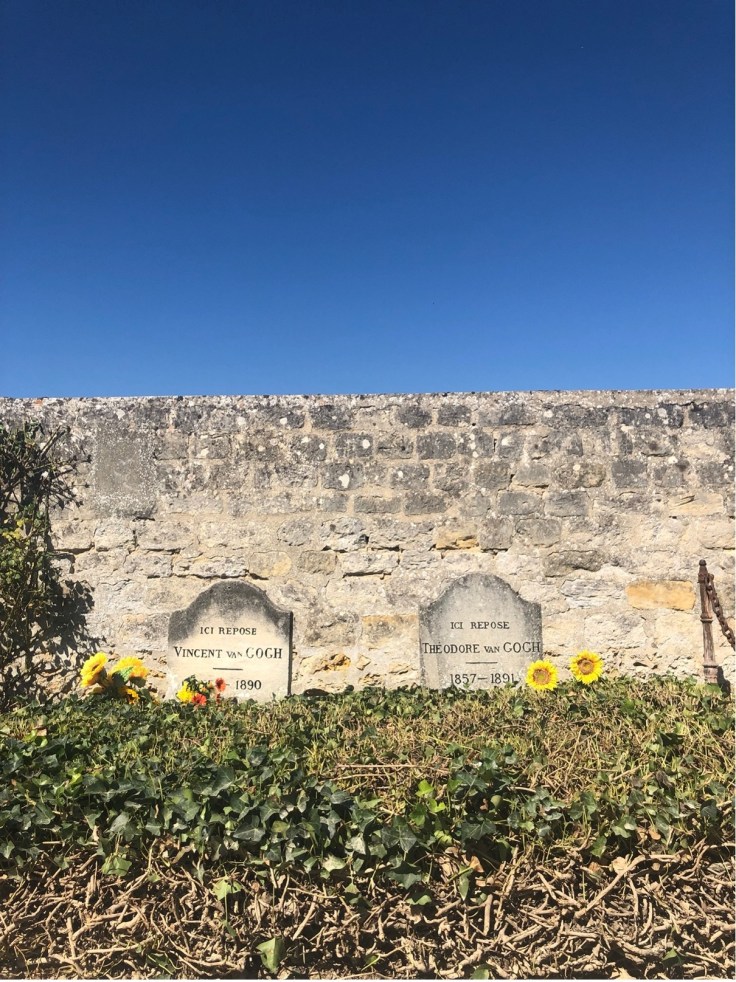
On a small plot of land in a town just beyond the boundaries of Paris, Vincent van Gogh lies beside his brother, two twin headstones denoting who rests where. The year I turned twenty-one, I visited van Gogh in Auvers-sur-Oise, walked the fields he captured in oil on canvas, touched the threshold of the stone building within which he ended himself. Sunflowers grew beside and atop his body. Three years earlier, I first glimpsed his The Langlois Bridge at Arles in the Wallraf-Richartz Museum in Cologne, Germany; the quiet gallery room fell away as I regarded the revered piece, instilling within me a passionate obsession with the work and its artist. I returned the following day to simply sit and study it. Years later, I remain enraptured by the painting’s craft, poignancy, and nuanced complexities.
In her poem “I Cannot Say I Did Not,” Sharon Olds probes the meaning of her narrator’s personal origins, and in doing so, lays out a canvas of wonderings which ponders what it means to love, live, and die: “Did I ask/ with the space in the ground, like a portion of breath,/ where my body will rest when it is motionless,/ when its elements move back into the earth?” Van Gogh’s headstone marks the date of his death as 1890; he was thirty-seven years old.
The double-beam Langlois Bridge drawbridge, built in the first half of the 19th century, connected Port-de-Bouc to Arles, spanning the waters of the canal beneath. In 1930, a reinforced-concrete structure replaced the original bridge, whose skeletal frame began to fail structurally. This second iteration lasted until the Second World War, when the Germans blew it up as a part of their tactic to eradicate all bridges along the canal. Today, the reconstructed bridge bears van Gogh’s namesake and lies a few kilometers away along the waterway from its original location.
Olds begins her poem with the narrator’s birth, which of course is not a beginning but a continuation of her mother (“I asked with my mother’s beauty,/ and her money”) and her father (“I asked with my father’s desire/ for his orgasms and for my mother’s money”), and the intricate relationship her parents shared quickly evidences nuanced complexities at once too fragile to breach yet nonetheless painfully familiar.
The Langlois Bridge at Arles captures the delicate blue of the sky and the shadowed blue of the canal water, the horizon line between the two separated symmetrically by the Langlois Bridge in light yellow. Van Gogh ultimately composed three paintings of the bridge, each with varying detail differences, the central subject of the bridge remaining the same. In one iteration, a woman walks beneath a parasol along the bridge path; in another, women reach into the river washing linens, their wooden boat parallel to the water beside them. Off in the distance, the spines of two cypress trees stretch quietly up into the sky. The yellow tones of the bridge and river embankment compliment the blues of the water and sky; other shades present in the work are subtle and used only to capture shadow, denote flora, present people.
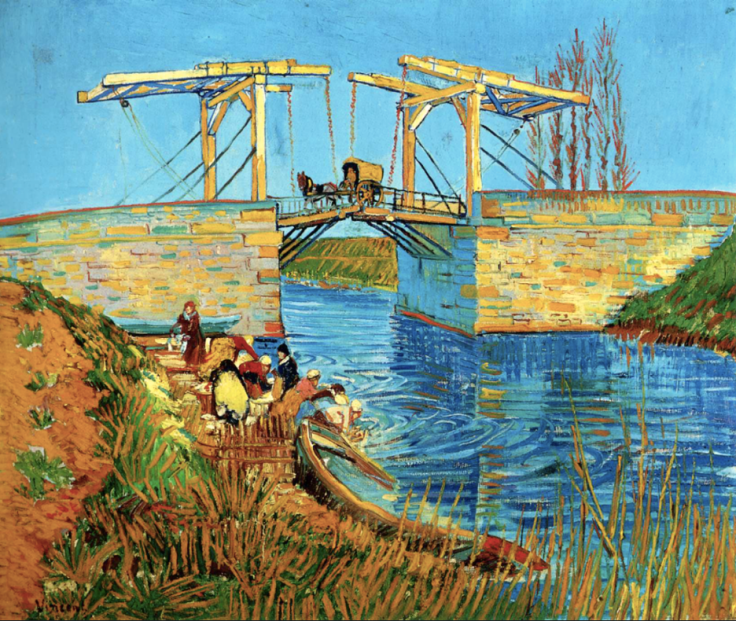
This is a romantic rendering, which transcends the viewer beyond the reality of the scene and into a world where a multitude of colors exists in the mere hues of yellow and blue; where completing the washing in the river appears mystical; where wandering along the quiet of the countryside transports one into a world bursting with intricate wonders, if only one should have the courage to observe them. Mirroring certain aspects of the painting in the fate which brought her into being, Olds’ narrator recalls how before she was born, she “asked with geometry, with/ origami, with swimming, […] with/ what [her] mind would thirst to learn,” and it was these curiosities imbedded into her becoming which resulted in her ultimate, inevitable creation.
The precise lines of the Langlois Bridge cut the paining with a geometric symmetry, luring the viewer closer to the river, where women with rounded faces sitting atop a curved riverbend reach into the water and the water reaches out past the frame. Similar to Olds’ narrator recollecting her existence, the mundanity of the moment captured in paint becomes more than the actuality it depicts: the movement of brushstrokes paired with the heightened vibrancy of the complimentary hues transforms a simple southern countryside occurrence to something revered for its mastered artistry. Like Olds, van Gogh understood that beyond the apparent boundaries of a moment, numerous other emotions, possibilities, and thoughts exist before and beyond, pressing in and around the moment which they ultimately create: works of art as the resultant diamonds from this constraint.
Though separated from the actual realization of this work by over a century, I feel the emotion of the painting within me as though I were one of the women reaching into the blue depths of the offshoot canals, as though I were a painter whose afternoons in the French countryside were dedicated to studying the movement of nature and society as they intersect and cross each other, as the bridge connects the land over the canal. Even now I wonder at the foundational lines, the way the color moves, how such a seemingly simple scene manages to cast such a captivating spell. I imagine myself a woman with a parasol walking across the wooden beams, looking out over my shoulder to where a man with an easel bends focused over his canvas. Olds’ narrator understands the feeling of intimately knowing something seeming unreachable within one’s own existence: “I asked, with everything I did not/ have, to be born.”
In a letter, van Gogh affirmed, “I hope to depart in no other way than looking back with love and wistfulness and thinking, oh paintings that I would have made.” Perhaps he understood he would die early; perhaps, as with the narrator’s birth, van Gogh understood a force unmeasurable to be at work: “There was only the asking/ for being, and then the being, the turn/ taken.”
As I walked the golden wheat fields stretching out and beyond van Gogh’s grave in Auvers-sur-Oise, I imagined what he could have created had his life been longer. Perhaps the uncertainties of the unfinished are answer enough for my wonderings: what was created by his hands is already the work of love and dedication which hangs proud and mighty as the epitome of an artist whose profound capabilities shifted the way the world considered both painting and reality. What Olds put into language, van Gogh swirled with colors: “I want to say that love/ is the meaning, but I think that love may be/ the means, what we ask with.” I carry this sense of love with me, understanding through the synthesis of these artworks how omnipotent and evanescent it to be.
References:
“Langlois Bridge at Arles.”Wikipedia, Wikimedia Foundation, 2 Apr. 2023, https://en.wikipedia.org/wiki/Langlois_Bridge_at_Arles.
“The Langlois Bridge at Arles, 1888 by Vincent Van Gogh.”The Langlois Bridge at Arles, 1888 by Vincent Van Gogh, Vincent Van Gogh, Paintings, Drawings, Quotes, and Biography, 2009, https://www.vincentvangogh.org/langlois-bridge-at-arles.jsp.
Roskill, Mark W. “van Gogh’s Exchanges of Work with Emile Bernard in 1888.” Oud Holland, vol. 86, no. 2/3, 1971, pp. 142–79. JSTOR, http://www.jstor.org/stable/42710890. Accessed 6 Apr. 2023.
Olds, Sharon. “‘I Cannot Say I Did Not.’”The New Yorker, The New Yorker, 2 Sept. 2019, https://www.newyorker.com/magazine/2019/09/09/i-cannot-say-i-did-not.
Ashley Elizabeth Trotter is a writer, essayist, and scholar of literature of the 18th and 19th centuries. She writes in Colorado and Massachusetts, where she has contributed editorially to various local literary publications.
 After the Art